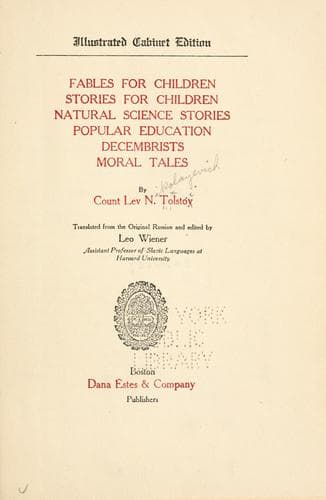
Fables for Children, Stories for Children, Natural Science Stories, Popular Education, Decembrists, Moral TalesTolstoy, Leo, graf
General
Fables for Children, Stories for Children, Natural Science Stories, Popular Education, Decembrists, Moral Tales
Tolstoy, Leo, graf
Russian literature -- Translations into English
The whole place, on which the city stands, is very cheerful. From the
mountain flow the hot springs, and at the foot of the mountain is the
river Podkúmok. On the slopes of the mountain are forests; all around
the city are fields, and in the distance are seen the mountains of the
Caucasus. On these the snow never melts, and they are always as white as
sugar. One large mountain, Elbrus, is like a white loaf of sugar; it can
be seen from everywhere when the weather is clear. People come to the
hot springs to be cured, and over them there are arbours and awnings,
and all around them are gardens with walks. In the morning the music
plays, and people drink the water, or bathe, or stroll about.
The city itself is on the mountain, but at the foot of it there is a
suburb. I lived in that suburb in a small house. The house stood in a
yard, and before the windows was a small garden, and in the garden stood
the landlord's beehives, not in hollow stems, as in Russia, but in
round, plaited baskets. The bees are there so gentle that in the morning
I used to sit with Búlka in that garden, amongst the beehives.
Búlka walked about between the hives, and sniffed, and listened to the
bees' buzzing; he walked so softly among them that he did not interfere
with them, and they did not bother him.
One morning I returned home from the waters, and sat down in the garden
to drink coffee. Búlka began to scratch himself behind his ears, and
made a grating noise with his collar. The noise worried the bees, and so
I took the collar off. A little while later I heard a strange and
terrible noise coming from the city. The dogs barked, howled, and
whimpered, people shouted, and the noise descended lower from the
mountain and came nearer and nearer to our suburb.
Búlka stopped scratching himself, put his broad head with its white
teeth between his fore legs, stuck out his tongue as he wished, and lay
quietly by my side. When he heard the noise he seemed to understand what
it was. He pricked his ears, showed his teeth, jumped up, and began to
snarl. The noise came nearer. It sounded as though all the dogs of the
city were howling, whimpering, and barking. I went to the gate to see
what it was, and my landlady came out, too. I asked her:
"What is this?"
She said:
"The prisoners of the jail are coming down to kill the dogs. The dogs
have been breeding so much that the city authorities have ordered all
the dogs in the city to be killed."
"So they would kill Búlka, too, if they caught him?"
"No, they are not allowed to kill dogs with collars."
Just as I was speaking, the prisoners were coming up to our house. In
front walked the soldiers, and behind them four prisoners in chains. Two
of the prisoners had in their hands long iron hooks, and two had clubs.
In front of our house, one of the prisoners caught a watch-dog with his
hook and pulled it up to the middle of the street, and another began to
strike it with the club.
Public-domain text, read in full here on John Shaqi.
Reviews
Reviews
No reviews yet
Be the first to share your thoughts on this work.
Join the Discussion
Join the discussion
Sign in to leave a comment or review.
Sign InorCreate an account