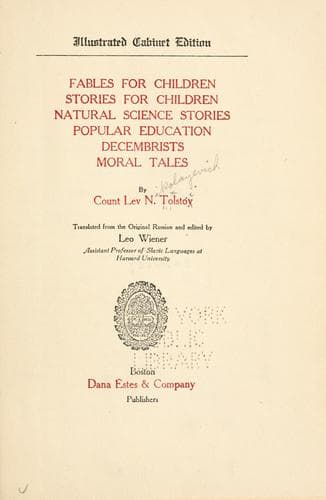
Fables for Children, Stories for Children, Natural Science Stories, Popular Education, Decembrists, Moral Tales — John Shaqi
Fables for Children, Stories for Children, Natural Science Stories, Popular Education, Decembrists, Moral TalesTolstoy, Leo, graf
General
Fables for Children, Stories for Children, Natural Science Stories, Popular Education, Decembrists, Moral Tales
Tolstoy, Leo, graf
Russian literature -- Translations into English
The little dog whined dreadfully, but the prisoners shouted and laughed.
The prisoner with the hook turned over the dog, and when he saw that it
was dead, he pulled out the hook and looked around for other dogs.
Just then Búlka rushed headlong at that prisoner, as though he were a
bear. I happened to think that he was without his collar, so I shouted:
"Búlka, back!" and told the prisoners not to strike the dog. But the
prisoner laughed when he saw Búlka, and with his hook nimbly struck him
and caught him by his thigh. Búlka tried to get away; but the prisoner
pulled him up toward him and told the other prisoner to strike him. The
other raised his club, and Búlka would have been killed, but he jerked,
and broke the skin at the thigh and, taking his tail between his legs,
flew, with the red sore on his body, through the gate and into the
house, and hid himself under my bed.
He was saved because the skin had broken in the spot where the hook
was.
BÚLKA'S AND MILTON'S END
Búlka and Milton died at the same time. The old Cossack did not know how
to get along with Milton. Instead of taking him out only for birds, he
went with him to hunt wild boars. And that same fall a tusky boar ripped
him open. Nobody knew how to sew him up, and so he died.
Búlka, too, did not live long after the prisoners had caught him. Soon
after his salvation from the prisoners he began to feel unhappy, and
started to lick everything that he saw. He licked my hands, but not as
formerly when he fawned. He licked for a long time, and pressed his
tongue against me, and then began to snap. Evidently he felt like biting
my hand, but did not want to do so. I did not give him my hand. Then he
licked my boot and the foot of a table, and then he began to snap at
these things. That lasted about two days, and on the third he
disappeared, and no one saw him or heard of him.
He could not have been stolen or run away from me. This happened six
weeks after the wolf had bitten him. Evidently the wolf had been mad.
Búlka had gone mad, and so went away. He had what hunters call the
rabies. They say that this madness consists in this, that the mad animal
gets cramps in its throat. It wants to drink and cannot, because the
water makes the cramps worse. And so it gets beside itself from pain and
thirst, and begins to bite. Evidently Búlka was beginning to have these
cramps when he started to lick and then to bite my hand and the foot of
the table.
I went everywhere in the neighbourhood and asked about Búlka, but could
not find out what had become of him, or how he had died. If he had been
running about and biting, as mad dogs do, I should have heard of him. No
doubt he ran somewhere into a thicket and there died by himself.
The hunters say that when an intelligent dog gets the rabies, he runs to
the fields and forests, and there tries to find the herb which he needs,
and rolls in the dew, and gets cured. Evidently Búlka never got cured.
He never came back.
THE GRAY HARE
Public-domain text, read in full here on John Shaqi.
Reviews
Reviews
No reviews yet
Be the first to share your thoughts on this work.
Join the Discussion
Join the discussion
Sign in to leave a comment or review.
Sign InorCreate an account