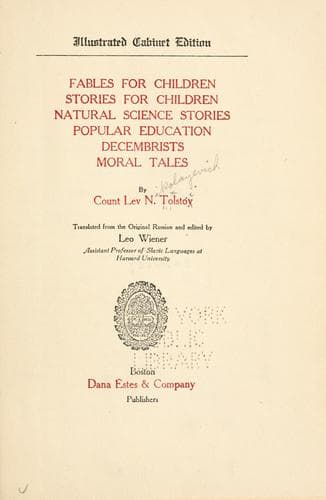
Fables for Children, Stories for Children, Natural Science Stories, Popular Education, Decembrists, Moral Tales — John Shaqi
Fables for Children, Stories for Children, Natural Science Stories, Popular Education, Decembrists, Moral TalesTolstoy, Leo, graf
General
Fables for Children, Stories for Children, Natural Science Stories, Popular Education, Decembrists, Moral Tales
Tolstoy, Leo, graf
Russian literature -- Translations into English
Aksénov looked, and saw that they had taken out a blood-stained knife
from his bag, and he was frightened "How did the blood get on the
knife?"
Aksénov wanted to answer, but could not pronounce a word.
"I--I do not know--I--the knife--is not mine!"
Then the chief said:
"In the morning the merchant was found in his bed with his throat cut.
No one but you could have done it. The house was locked from within, and
there was no one in the house but you. Here is the bloody knife in your
bag, and your face shows your guilt. Tell me, how did you kill him, and
how much money did you rob him of?"
Aksénov swore that he had not done it; that he had not seen the merchant
after drinking tea with him; that he had with him his own eight
thousand; that the knife was not his. But his voice faltered, his face
was pale, and he trembled from fear, as though he were guilty.
The chief called in the soldiers, told them to bind him and to take him
to the cart. When he was rolled into the cart with his legs tied, he
made the sign of the cross and began to cry. They took away his money
and things, and sent him to jail to the nearest town. They sent to
Vladímir to find out what kind of a man Aksénov was, and all the
merchants and inhabitants of Vladímir testified to the fact that Aksénov
had drunk and caroused when he was young, but that he was a good man.
Then they began to try him. He was tried for having killed the Ryazán
merchant and having robbed him of twenty thousand roubles.
The wife was grieving for her husband and did not know what to think.
Her children were still young, and one was still at the breast. She took
them all and went with them to the town where her husband was kept in
prison. At first she was not admitted, but later she implored the
authorities, and she was taken to her husband. When she saw him in
prison garb and in chains, together with murderers, she fell to the
ground and could not come to for a long time. Then she placed her
children about her, sat down beside him, and began to tell him about
house matters, and to ask him about everything which had happened. He
told her everything. She said:
"What shall I do?"
He said:
"We must petition the Tsar. An innocent man cannot be allowed to
perish."
His wife said that she had already petitioned the Tsar, but that the
petition had not reached him. Aksénov said nothing, and only lowered his
head. Then his wife said:
"You remember the dream I had about your getting gray. Indeed, you have
grown gray from sorrow. If you had only not started then!"
And she looked over his hair, and said:
"Iván, my darling, tell your wife the truth: did you not do it?"
Aksénov said, "And you, too, suspect me!" and covered his face with his
hands, and began to weep.
Then a soldier came, and told his wife that she must leave with her
children. And Aksénov for the last time bade his family farewell.
Public-domain text, read in full here on John Shaqi.
Reviews
Reviews
No reviews yet
Be the first to share your thoughts on this work.
Join the Discussion
Join the discussion
Sign in to leave a comment or review.
Sign InorCreate an account