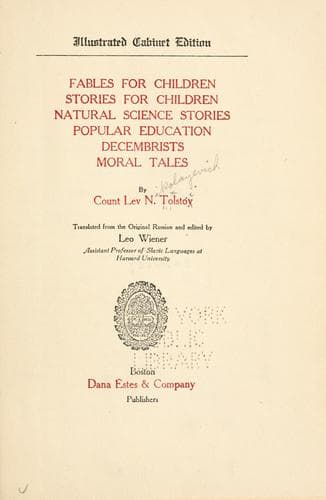
Fables for Children, Stories for Children, Natural Science Stories, Popular Education, Decembrists, Moral Tales — John Shaqi
Fables for Children, Stories for Children, Natural Science Stories, Popular Education, Decembrists, Moral TalesTolstoy, Leo, graf
General
Fables for Children, Stories for Children, Natural Science Stories, Popular Education, Decembrists, Moral Tales
Tolstoy, Leo, graf
Russian literature -- Translations into English
When his wife had left, Aksénov thought about what they had been talking
of. When he recalled that his wife had also suspected him and had asked
him whether he had killed the merchant, he said to himself: "Evidently
none but God can know the truth, and He alone must be asked, and from
Him alone can I expect mercy." And from that time on Aksénov no longer
handed in petitions and stopped hoping, but only prayed to God.
Aksénov was sentenced to be beaten with the knout, and to be sent to
hard labour. And it was done.
He was beaten with the knout, and later, when the knout sores healed
over, he was driven with other convicts to Siberia.
In Siberia, Aksénov passed twenty-six years at hard labour. His hair
turned white like snow, and his beard grew long, narrow, and gray. All
his mirth went away. He stooped, began to walk softly, spoke little,
never laughed, and frequently prayed to God.
In the prison Aksénov learned to make boots, and with the money which he
earned he bought himself the "Legends of the Holy Martyrs," and read
them while it was light in the prison; on holidays he went to the prison
church and read the Epistles, and sang in the choir,--his voice was
still good. The authorities were fond of Aksénov for his gentleness, and
his prison comrades respected him and called him "grandfather" and
"God's man." When there were any requests to be made of the authorities,
his comrades always sent him to speak for them, and when the convicts
had any disputes between themselves, they came to Aksénov to settle
them.
No one wrote Aksénov letters from his home, and he did not know whether
his wife and children were alive, or not.
Once they brought some new prisoners to the prison. In the evening the
old prisoners gathered around the new men, and asked them from what town
they came, or from what village, and for what acts they had been sent
up. Aksénov, too, sat down on the bed-boards near the new prisoners and,
lowering his head, listened to what they were saying. One of the new
prisoners was a tall, sound-looking old man of about sixty years of age,
with a gray, clipped beard. He was telling them what he had been sent up
for:
"Yes, brothers, I have come here for no crime at all. I had unhitched a
driver's horse from the sleigh. I was caught. They said, 'You stole it.'
And I said, 'I only wanted to get home quickly, for I let the horse go.
Besides, the driver is a friend of mine. I am telling you the
truth.'--'No,' they said, 'you have stolen it.' But they did not know
what I had been stealing, or where I had been stealing. There were
crimes for which I ought to have been sent up long ago, but they could
not convict me, and now I am here contrary to the law. 'You are
lying,--you have been in Siberia, but you did not make a long visit
there--'"
"Where do you come from?" asked one of the prisoners.
"I am from the city of Vladímir, a burgher of that place. My name is
Makár, and by my father Seménovich."
Aksénov raised his head, and asked:
Public-domain text, read in full here on John Shaqi.
Reviews
Reviews
No reviews yet
Be the first to share your thoughts on this work.
Join the Discussion
Join the discussion
Sign in to leave a comment or review.
Sign InorCreate an account