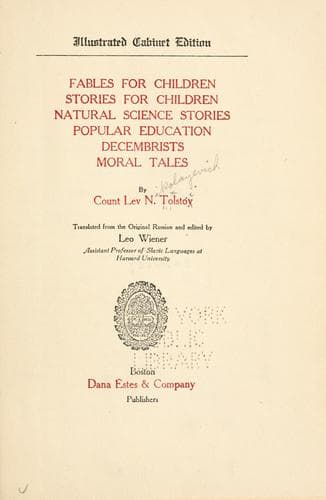
Fables for Children, Stories for Children, Natural Science Stories, Popular Education, Decembrists, Moral TalesTolstoy, Leo, graf
General
Fables for Children, Stories for Children, Natural Science Stories, Popular Education, Decembrists, Moral Tales
Tolstoy, Leo, graf
Russian literature -- Translations into English
"Seménovich, have you not heard in Vladímir about the family of Merchant
Aksénov? Are they alive?"
"Yes, I have heard about them! They are rich merchants, even though
their father is in Siberia. He is as much a sinner as I, I think. And
you, grandfather, what are you here for?"
Aksénov did not like to talk of his misfortune. He sighed, and said:
"For my sins have I passed twenty-six years at hard labour."
Makár Seménovich said:
"For what sins?"
Aksénov said, "No doubt, I deserved it," and did not wish to tell him
any more; but the other prison people told the new man how Aksénov had
come to be in Siberia. They told him how on the road some one had killed
a merchant and had put the knife into his bag, and he thus was sentenced
though he was innocent.
When Makár Seménovich heard that, he looked at Aksénov, clapped his
knees with his hands, and said:
"What a marvel! What a marvel! But you have grown old, grandfather!"
He was asked what he was marvelling at, and where he had seen Aksénov,
but Makár Seménovich made no reply, and only said:
"It is wonderful, boys, where we were fated to meet!"
And these words made Aksénov think that this man might know something
about who had killed the merchant. He said:
"Seménovich, have you heard before this about that matter, or have we
met before?"
"Of course I have heard. The earth is full of rumours. That happened a
long time ago: I have forgotten what I heard," said Makár Seménovich.
"Maybe you have heard who killed the merchant?" asked Aksénov.
Makár Seménovich laughed and said:
"I suppose he was killed by the man in whose bag the knife was found.
Even if somebody stuck that knife into that bag, he was not caught, so
he is no thief. And how could the knife have been put in? Was not the
bag under your head? You would have heard him."
The moment Aksénov heard these words, he thought that that was the man
who had killed the merchant. He got up and walked away. All that night
Aksénov could not fall asleep. He felt sad, and had visions: now he saw
his wife such as she had been when she bade him farewell for the last
time, as he went to the fair. He saw her, as though she was alive, and
he saw her face and eyes, and heard her speak to him and laugh. Then he
saw his children such as they had been then,--just as little,--one of
them in a fur coat, the other at the breast. And he thought of himself,
such as he had been then,--gay and young; he recalled how he had been
sitting on the porch of the hostelry, where he was arrested, and had
been playing the guitar, and how light his heart had been then. And he
recalled the pillory, where he had been whipped, and the executioner,
and the people all around, and the chains, and the prisoners, and his
prison life of the last twenty-six years, and his old age. And such
gloom came over him that he felt like laying hands on himself.
"And all that on account of that evil-doer!" thought Aksénov.
Public-domain text, read in full here on John Shaqi.
Reviews
Reviews
No reviews yet
Be the first to share your thoughts on this work.
Join the Discussion
Join the discussion
Sign in to leave a comment or review.
Sign InorCreate an account