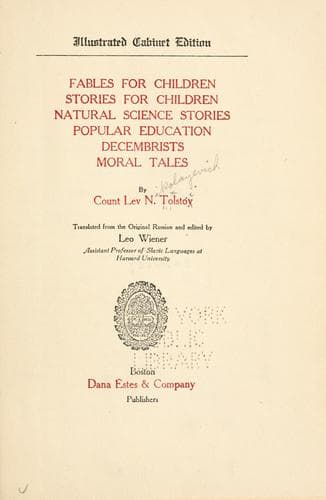
Fables for Children, Stories for Children, Natural Science Stories, Popular Education, Decembrists, Moral Tales — John Shaqi
Fables for Children, Stories for Children, Natural Science Stories, Popular Education, Decembrists, Moral TalesTolstoy, Leo, graf
General
Fables for Children, Stories for Children, Natural Science Stories, Popular Education, Decembrists, Moral Tales
Tolstoy, Leo, graf
Russian literature -- Translations into English
"Now you," he said, "are a cross fellow, but your friend is meek; he has
written a letter home, and they will send five thousand roubles. He will
be fed well, and will not be insulted."
So Zhilín said:
"My friend may do as he pleases; maybe he is rich, but I am not. As I
have said, so will it be. If you want to, kill me,--you will not gain by
it,--but more than five hundred will I not give."
They were silent for awhile. Suddenly Abdul jumped up, fetched a small
box, took out a pen, a piece of paper, and some ink, put it all before
Zhilín, slapped him on the shoulder, and motioned for him to write. He
agreed to the five hundred.
"Wait awhile," Zhilín said to the interpreter. "Tell him that he has to
feed us well, and give us the proper clothes and shoes, and keep us
together,--it will be jollier for us,--and take off the stocks." He
looked at the master and laughed. The master himself laughed. He
listened to the interpreter, and said:
"I will give you the best of clothes,--a Circassian mantle and
boots,--you will be fit to marry. We will feed you like princes. And if
you want to stay together, you may live in the shed. But the stocks
cannot be taken off, for you will run away. For the night we will take
them off."
He ran up to Zhilín, and tapped him on the shoulder:
"You goot, me goot!"
Zhilín wrote the letter, but he did not address it right. He thought he
would run away.
Zhilín and Kostylín were taken back to the shed. They brought for them
maize straw, water in a pitcher, bread, two old mantles, and worn
soldier boots. They had evidently been pulled off dead soldiers. For the
night the stocks were taken off, and they were locked in the barn.
III.
Zhilín and his companion lived thus for a whole month. Their master kept
laughing.
"You, Iván, goot, me, Abdul, goot!"
But he did not feed them well. All he gave them to eat was unsalted
millet bread, baked like pones, or entirely unbaked dough.
Kostylín wrote home a second letter. He was waiting for the money to
come, and felt lonesome. He sat for days at a time in the shed counting
the days before the letter would come, or he slept. But Zhilín knew
that his letter would not reach any one, and so he did not write
another.
"Where," he thought, "is my mother to get so much money? As it is, she
lived mainly by what I sent her. If she should collect five hundred
roubles, she would be ruined in the end. If God grants it, I will manage
to get away from here."
And he watched and thought of how to get away.
He walked through the village and whistled, or he sat down somewhere to
work with his hands, either making a doll from clay, or weaving a fence
from twigs. Zhilín was a great hand at all kinds of such work.
Public-domain text, read in full here on John Shaqi.
Reviews
Reviews
No reviews yet
Be the first to share your thoughts on this work.
Join the Discussion
Join the discussion
Sign in to leave a comment or review.
Sign InorCreate an account