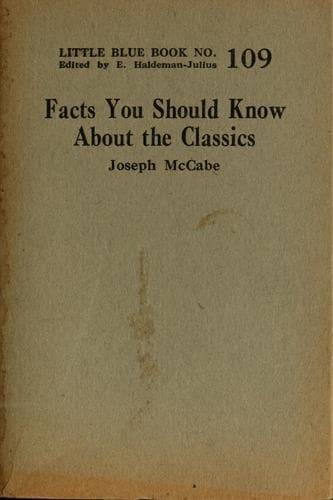
Facts you should know about the classicsMcCabe, Joseph
History
Facts you should know about the classics
McCabe, Joseph
Literature -- History and criticism
The other point is that recent attempts to make Shakespeare less
titanic than tradition represents him are not soundly critical. Every
reader knows that he is unequal in his inspiration and one can select
lines and passages of no distinction. It is, moreover, a question if
some of the plays which bear his name were really written by him. Take
him as a whole, and in the essential qualities of the poet--which are
the expression of things in beautiful images and exquisite little
allegories and the use of language of a fitting tone--he surpasses
every other poet. I have read at least something of Homer, Hesiod,
Aeschylus, Euripides, Vergil, Horace, Dante, Tasso, Racine, Corneille,
Calderon, Goethe, and Schiller in their own tongues, and that is my
confident judgment. Some modern writers who attack Shakespeare’s
supremacy cannot, apparently, read his rivals in the original.
But Shakespeare requires a volume or nothing, and we will take him for
granted as the first classic. Of Francis Bacon also we must say little.
His chief works (_Novum Organon_, etc.) were written in Latin and
belong to the history of thought, not of letters. His English _Essays_
may be considered a classic. Ben Jonson (1574-1637), finally, though
called “rare Ben Jonson” in his time for his beautiful lyrics, pungent
comedies, and classical tragedies, is now rarely read.
English literature, in fact, now became a ceaseless and ever broadening
stream, and, with all the interests of our modern literature, we have
little time, unless we are special students, to read any but the
supreme writers of the earlier days. The Authorized Version of the
Bible itself is a wonderful monument of the artistic splendor of that
age. Fifty divines, not poets, were set to prepare the translation,
from 1605 to 1610, and, wherever the Hebrew text is itself poetic--the
far greater part of it (Pentateuch, historical books, etc.) is not at
all fine literature--they rendered it in magnificent, sonorous English.
The _Anatomy of Melancholy_ by Robert Burton (1577-1640) and the
_Religio Medici_ of Sir Thomas Browne, a distinguished physician
(1605-82), may be selected as the best classics. After these we get
poets like Vaughan and Herrick, who are scarcely great enough to be
included here, and then John Milton (1608-74), the second greatest poet
of the English tongue as well as a sound and deep thinker and a most
learned man for his age.
Public-domain text, read in full here on John Shaqi.
Reviews
Reviews
No reviews yet
Be the first to share your thoughts on this work.
Join the Discussion
Join the discussion
Sign in to leave a comment or review.
Sign InorCreate an account