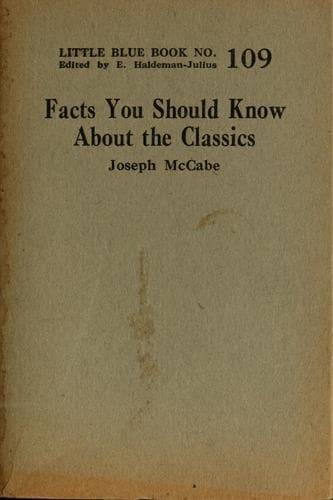
Facts you should know about the classics — John Shaqi
Facts you should know about the classicsMcCabe, Joseph
History
Facts you should know about the classics
McCabe, Joseph
Literature -- History and criticism
Milton’s masterpiece is, of course, _Paradise Lost_. Like Dante,
he would show that the Christian creed could inspire an epic as
effectively as pagan legends, and no doubt on that account he is, like
Dante, less read today than if he had remained purely secular. There
is, however, a further parallel which is often missed. Just as Dante
rationalizes Purgatory and is not orthodox on many points, so Milton
more or less rationalizes Satan and hell. His Prince of Darkness is
by no means the horned devil of ordinary believers, and we know that
he had, in fact, very liberal ideas. In any case, the poetry is as
magnificent as the conception, from the artistic point of view, is
grand. It certainly puts John Milton in the highest circle of the
immortals. One ought to read some of his other great poems to correct
the common idea that he was absorbed entirely in biblical stories, and
I would recommend every one to read, of his superb prose work, at least
the _Areopagitica_, an address to Parliament on the liberty of the
press. Milton was far from medieval in his social ideals.
As I have already said, we are here dealing with writers who are on the
turn from the medieval to the modern age. It is difficult to draw the
line, but for my purpose of giving just an idea of the position and
character of each classic I may take the spread of Deism in Europe as
the beginning of the modern period and carry this section as far as the
poet Pope.
One classic of Milton’s time that ought to be read is the _Hudibras_
of Samuel Butler (1612-80). Butler had the brilliant idea that the
sour Puritan was the Don Quixote of English life and this poem is a
delicious satire of the type. Royalty was by that time restored, and
everybody was prepared to laugh at the men who had made England sober
and dismal for a generation. The humor of _Hudibras_ is so rich that it
is always worth reading.
A very different classic of the age is John Bunyan’s _Pilgrim’s
Progress_, perhaps the most widely read religious book, apart from the
Bible, that was ever written. Bunyan (1628-88) was a pious thinker,
but a literary genius. His allegorical figures will never cease to be
quoted. Izaak Walton’s _Compleat Angler_ is another work of the time
that comes near being a classic, and Milton’s friend, Andrew Marvell,
wrote some superb nature-poetry. More frequently quoted now are the
Diaries of Pepys (1633-1703) and Evelyn (1620-1706). The former was a
superior civil servant, and he most minutely and pleasantly records
nine years of his life in London. Evelyn was a country gentleman and he
reflects the life of his class. They are both valuable and interesting.
Public-domain text, read in full here on John Shaqi.
Reviews
Reviews
No reviews yet
Be the first to share your thoughts on this work.
Join the Discussion
Join the discussion
Sign in to leave a comment or review.
Sign InorCreate an account