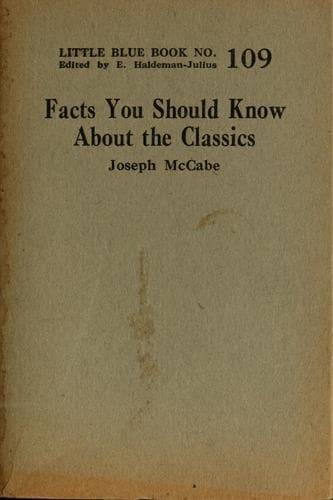
Facts you should know about the classicsMcCabe, Joseph
History
Facts you should know about the classics
McCabe, Joseph
Literature -- History and criticism
Francois Marie Arouet (1694-1778), who took the pen-name of Voltaire,
is one of the most remarkable writers of Europe. Competent critics
pronounce him the best poet of his age--an age not rich in great
poets, however--and in history (_The Age of Louis XIV_), tragedy, and
treatment of actual problems (_Letters on the English_, _Philosophical
Dictionary_, etc.) he had no superior. But it is as a prose-writer,
particularly as a caustic critic of the creed of his country, that he
made a reputation which filled the world and has made his name one
of the most familiar even in our own time. Such sparkling wit as he
had when allied with high poetic talent, profound knowledge of human
nature, and rare power of construction formed an ideal equipment for
the work to which he chiefly devoted his life. As in the case of
Shakespeare, it is useless to write a few paragraphs about him. What
little one could write would be known to the reader. Voltaire has to be
read, for you cannot adequately describe the flash and sparkle of his
prose. I have translated a few of his smaller pieces (_Selections from
Voltaire_) so as to give the general reader an idea of his versatility,
and several of his stories (read, especially, _Candide_, a satire on
foolish optimism) can be had in the Big Blue Book series (Nos. B-6 and
B-30). The world will never tire of reading Voltaire.
Jean Jacques Rousseau (1712-1778), his contemporary (but not friend),
was a constructive thinker and emotional writer. His _Social Contract_
is a classic of sociological literature, and his _Confessions_ is one
of the most masterly autobiographies ever written, as well as one of
the most candid. His _Émile_ and _The New Heloise_, a treatise on
education, are hardly less distinguished though now little read.
Two such writers at one time would enrich any country, but Count Buffon
(1707-88) must be associated with them as a great writer as well as
the most learned naturalist of his time. His _Natural History_, in
twenty-four volumes, is a literary masterpiece as well as a scientific
encyclopedia. At the same time lived Denis Diderot (1713-84) and a
group of writers associated with him. Though none of these is a classic
in the literary sense, the great _Encyclopedia_ which they jointly
wrote is very notable in the history of letters and thought.
A little later, during the Revolution, were Mme. de Stael, a French
woman married to a Swede, whose novels were long considered to be great
literature, and Chateaubriand, an orthodox Catholic, who (though I
find his name omitted from most literary histories) was a writer of
great power and often of rare beauty. His _Genius of Christianity_ was
certainly esteemed a classic for the next half century.
Public-domain text, read in full here on John Shaqi.
Reviews
Reviews
No reviews yet
Be the first to share your thoughts on this work.
Join the Discussion
Join the discussion
Sign in to leave a comment or review.
Sign InorCreate an account