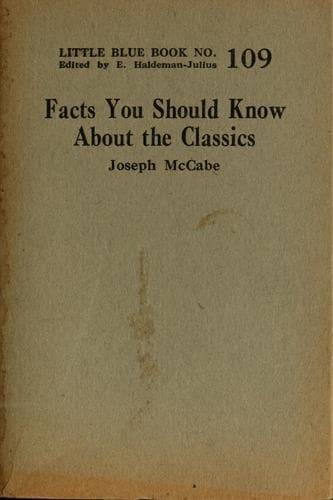
Facts you should know about the classicsMcCabe, Joseph
History
Facts you should know about the classics
McCabe, Joseph
Literature -- History and criticism
In the nineteenth century the elder Dumas (1802-70), author of _The
Three Musketeers_, _Twenty Years After_, _The Count of Monte Cristo_,
etc., and Victor Hugo (1802-85) inaugurated the great period of modern
French literature. Hugo was an astounding literary genius, both in
prose and poetry. His formidable novels, _Les Miserables_ (an epic of
the poor), _The Hunchback of Notre Dame_, etc., may contain all the
defects which critics find in them, but they are superb conceptions and
the world still reads them as classics. “George Sand” (1804-76) is not,
perhaps, read outside France today, but her position in letters is very
high. I might recommend her _Consuelo_, but it is of such length that
the modern reader would despair of getting through it. Her real name
was the Baroness Dudevant, though she lived apart from her husband, a
woman of passionate adventures. Her friend Alfred de Musset (1810-57)
wrote lyric poems of the highest quality as well as literary plays and
stories.
With the activity of these we reach the period of the second Revolution
in France, the middle of the nineteenth century and the list of
distinguished names is long. While it is premature to say which, if
any, of their works will rank as classics, Alfred de Vigny (1797-1863)
wrote, besides dramas and novels, exquisite poetry of the Romantic
school. “Stendhal” (really Henri Beyle, 1783-1842) had a very high
reputation as writer of novels (_The Chartreuse of Parma_, etc.) and
essays. Baudelaire (1821-67) was the second best (if not the best)
French poet of the century: his book of verse _Flowers of Evil_ is
certainly a classic. Honoré de Balzac (1799-1850) wrote ninety powerful
novels (especially the series called _The Human Comedy_, a natural
history of contemporary life) and was a master of the short story.
Gustave Flaubert (1821-80) was so high and conscientious an artist that
he wrote only four perfect novels. Guy de Maupassant, Prosper Mérimée,
the de Goncourt brothers (Jules and Edmond), T. Gautier, A. Daudet,
Sainte-Beuve, Verlaine (poet), Zola, Rostand (dramatist), and the
recently deceased Anatole France, the prince of modern story-writers,
make up--without mentioning living writers--a group of brilliant
writers who will long be remembered; and to these we ought to add
scholars like Renan, Taine, Thiers, Michelet, etc., who were little
less distinguished in literature.
§2. GERMANY, RUSSIA AND SCANDINAVIA
Apart from Luther, we have no German writer whom we would call a
classic until the second half of the nineteenth century. At the time
when the influence of the Renaissance might be expected to reach and
stimulate it the country was desolated by a hundred years of warfare
about religion. It recovered in the years before the French Revolution
and immediately there appeared two poets, Goethe and Schiller, who
belong to the highest company.
Public-domain text, read in full here on John Shaqi.
Reviews
Reviews
No reviews yet
Be the first to share your thoughts on this work.
Join the Discussion
Join the discussion
Sign in to leave a comment or review.
Sign InorCreate an account