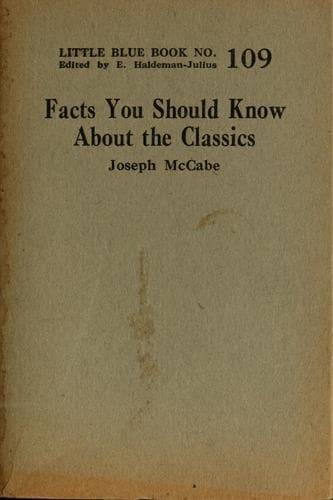
Facts you should know about the classicsMcCabe, Joseph
History
Facts you should know about the classics
McCabe, Joseph
Literature -- History and criticism
Goethe (1749-1832) takes rank with Shakespeare. Intellectually--he
was an ardent scientist and deep thinker as well as a great poet--he
surpassed Shakespeare and, perhaps on that account, is inferior to him
in the strictly poetic faculty of exquisite imagery. No other poet
could have conceived the vast design of _Faust_, at which he worked
for seventy years, and at least the opening soliloquy of Faust will
always be read. His earlier or romantic style is beautifully seen in
his story, _The Sorrows of Young Werther_, and the long novel (or pair
of novels) of his later years, _Wilhelm Meister_, is a masterpiece.
With his encyclopedic knowledge and his profound intellect Goethe
gives the whole epic of humanity, as known in his day, in his work. In
mid-life he came under the influence of the Greek and Roman classics,
and the result may be read in his stately and beautiful long poems
_Tasso_, _Iphigenia_, _Hermann and Dorothea_, etc. But he was masterly
in all that he touched, sonnet or tragedy, story or art-criticism or
scientific essay.
Schiller (1759-1805), his younger friend and contemporary, is in the
stricter sense a poet and dramatist, not a thinker, though he studied
philosophy and wrote a famous history of the Thirty Years War. His
chief plays (_Wallenstein_, _Maria Stuart_, _Don Carlos_, etc.,) are
classics, and his lyrics are superb. Goethe befriended and influenced
him, and they composed together some brilliant satirical verses or
epigrams on contemporary shams. Like Goethe he began to write in the
Romantic vein, but his later and finer work shows the chaste influence
of the Greek and Roman classics.
Notable amongst the predecessors or early contemporaries of Goethe was
Lessing (1729-80), whose works on art (_Laocoon, etc._), comedies,
tragedies, and essays gave him a very high rank. Klopstock, Wieland
and others, took a great part in the revival of letters in Germany,
but I must be content with only a few of the great names. The works
of the long and impressive line of German philosophers from Kant to
Schopenhauer, cannot be treated here. They are classics of philosophy,
but Heinrich Heine (1797-1856) was one of the most brilliant writers
of his time. He was the best German lyric writer after Goethe (see
his _Book of Songs_), wrote superb books of travel, and had a fund of
delicate irony and caustic wit that makes his prose always a delight.
Greater still--the greatest German writer after Goethe--was Friedrich
Nietzsche (1844-1900), whose volcanic and often beautiful prose-poetry
is of a unique order. His best work is _Thus Spake Zarathustra_,
a malicious choice of the austere Persian moralist Zarathustra
(or Zoroaster), as the mouthpiece of his own fiery indictment of
conventional moral ideas.
Public-domain text, read in full here on John Shaqi.
Reviews
Reviews
No reviews yet
Be the first to share your thoughts on this work.
Join the Discussion
Join the discussion
Sign in to leave a comment or review.
Sign InorCreate an account