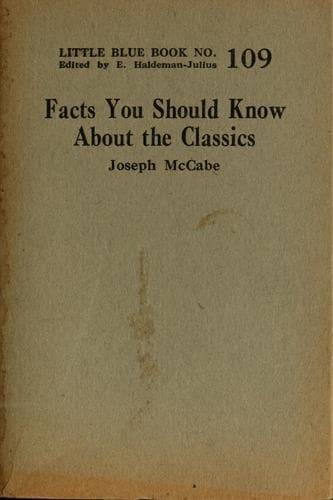
Facts you should know about the classics — John Shaqi
Facts you should know about the classicsMcCabe, Joseph
History
Facts you should know about the classics
McCabe, Joseph
Literature -- History and criticism
Tragedy, like the epic before it, and the comedy which followed it,
reflects the age in which it was born: just as we get snowdrops in the
spring, roses in the summer, and berries in the autumn. King’s courts
were by this time abolished and the crowd of citizens had to have their
entertainments. At the same time a deeper religious mood passed over
Greece, and in Aeschylus (born 523 B. C.) this came to inspire tragic
poetry which is artistically magnificent. There was an old custom of
having, on the festival of Dionysos, the god of dance and wine, a group
of men quaintly dressed who danced round his altar chanting old verses.
Out of this the poets created the play, and Athens built the first
great theater.
Aeschylus used ancient legends of tragic happenings that seemed to have
a profound and somber moral significance. Only seven of his seventy
tragedies have been preserved, and as Sir Gilbert Murray has in recent
years superbly translated three of the best of these (_Agamemnon_,
_Cheophori_, _Eumenides_) an English reader can get a very good idea
of his tragic grandeur. These three plays form a trilogy, or connected
series, founded on the terrible legend of the curse on the house of
King Agamemnon. Behind it all Aeschylus sees the action of a great
mysterious principle, Fate, greater than the gods, which brings
the punishment of crime. “Eumenides” means the “Avenging Fates.”
_Prometheus Bound_, from which Shelley took the title of his great
“lyrical drama,” _Prometheus Unbound_, is another masterpiece of this
“father of tragedy.”
His rival and successor Sophocles (495-405) is considered even greater:
indeed, the greatest tragic poet of all time. In fact there are
experts who regard some of the masterpieces of Sophocles, such as the
_Antigone_ (which ought to be read in one of the current translations),
_Oedipus the King_, and _Electra_, as the finest works that were ever
written. The theme of them is, as in Aeschylus, that a semi-divine
Fate rules gods and men and avenges crime. Both tragedians take crime
on the grand scale--murder, rape, incest, etc., in the legends of the
old royal families--and the characters they create will live forever.
Sophocles, of whose one hundred and thirteen plays we have only seven,
is a little less somber, more humane, more polished than Aeschylus. He
creates tragic grandeur out of the moral and religious feelings of the
time.
Public-domain text, read in full here on John Shaqi.
Reviews
Reviews
No reviews yet
Be the first to share your thoughts on this work.
Join the Discussion
Join the discussion
Sign in to leave a comment or review.
Sign InorCreate an account