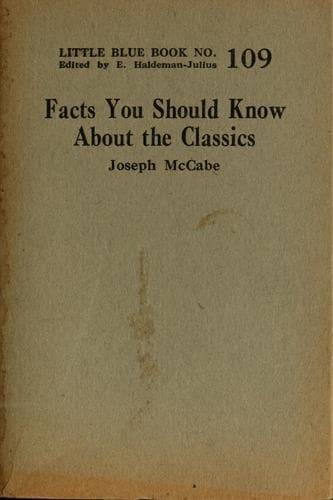
Facts you should know about the classics — John Shaqi
Facts you should know about the classicsMcCabe, Joseph
History
Facts you should know about the classics
McCabe, Joseph
Literature -- History and criticism
The contrast of the third and latest of the trio, Euripides (480-406),
is interesting. He was a cultivated man and clearly did not believe
the old legends in their religious side. Skepticism was growing in
Greece. But the mass of the people were religious, and Euripides was
not generally popular, though eighteen of his seventy-five plays have
survived. Technically he improves on his predecessors but he has not
the same glow of inspiration. He took similar themes to those of his
predecessors--crimes and tragedies on the royal scale--but he was a
more self-conscious artist and an intellectual. If you want to see how
he wrote Greek tragedy, read a translation of the _Medea_, which is
based upon the appalling crimes and tragic adventures of that legendary
queen; and, incidentally, it is one of the first pleas for a more just
treatment of women. _Alcestis_, _Iphigenia_, _Orestes_, etc., are other
masterpieces of Euripides.
Comedy was the next form invented by the Greek poets, and Aristophanes
(450-380), the greatest of the comedians, was a contemporary and
(being very conservative) a bitter enemy of Euripides and all
innovators. He satirized the growing woman-movement mercilessly in his
_Lysistrate_ and _Ecclesiazusae_, the philosophers in his _Clouds_, the
democrats in his _Knights_, the democratic judges in his _Wasps_, and
so on. But his wit was irresistible, and the stubborn old conservative
was an idol of the Athenian people for forty years. Of his fifty plays,
of which eleven survive, the _Clouds_ (against the intellectuals and
skeptics) is perhaps the best, though most mischievous. Translations
of all these ancient classics can be got in the Bohn, “Everyman,” and
other collections of great books.
Aristophanes was as free of speech in regard to sex as he was zealous
for old creeds. A refinement of comedy came after his time, and the
ablest representative of this “New Comedy,” reflecting the real
domestic life of the Greeks, was “the gentle Menander.” But we have
only fragments of his comedies. Aristophanes, the loosest, is the only
comedian of whom entire plays have been preserved, and we must now take
their tone as typically Greek. The austere moralists Sophocles and
Euripides, remember, lived at the same time and were played before the
same audiences.
History was a third line of development at the time, and two of the
Greek historians, Herodotus (“the Father of History,” 484-425) and
Thucydides (471-400) are classics. The former, who had traveled all
over the civilized world, wrote mainly on the clash of the Greeks
and the Persians, but he brings in the whole world which he has seen.
The plan is imposing, but he is not critical, and not always reliable
even about countries which he visited. Thucydides chiefly describes
the Peloponnesian War (with Sparta) and is terser and more faithful to
facts. His work is history in the modern sense and finely written.
Public-domain text, read in full here on John Shaqi.
Reviews
Reviews
No reviews yet
Be the first to share your thoughts on this work.
Join the Discussion
Join the discussion
Sign in to leave a comment or review.
Sign InorCreate an account