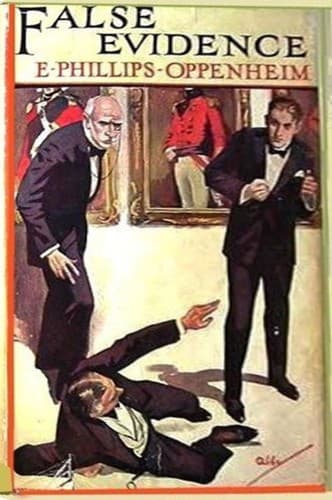
False EvidenceOppenheim, E. Phillips (Edward Phillips)
General
False Evidence
Oppenheim, E. Phillips (Edward Phillips)
Soldiers -- Fiction
"The old man was cut about a bit, but not seriously injured.
Richard--that's the son, you know--came off very easily, and was able
to tell us all about it. Can't say much about it, Arbuthnot, my boy,
for the doctor has given orders that there's to be no talking; but you
behaved splendidly, just as I should like my own son to have behaved,"
he added, in a somewhat husky tone.
"What's become of the man they caught?" I asked.
"Remanded without bail until you can give evidence, which you won't be
able to do just yet," was the reply. "And now you're not to talk any
more. Not another word, sir," he added, sharply, in a tone of command
which he often used, and which came naturally from him, as it does from
any born soldier. And, of course, I obeyed.
The short period of my illness was made as pleasant for me as kindness
and every luxury could make it. Marian was given a room close to mine,
and Sir Francis had also insisted upon sending for a trained nurse from
York Infirmary. All night she sat up with me, although it was quite
unnecessary, for all symptoms of the brain fever, which the doctor had
feared was impending, had disappeared, and I invariably slept well.
And all day Marian was with me, whilst Lady Olive and, more rarely,
Maud Devereux paid me occasional visits. My most regular daily
visitor, though, was Sir Francis himself. Every afternoon I woke up
from my doze to see his tall, stately figure moving softly about the
room, or sitting in the high-backed chair by my side. And sometimes I
found him with his eyes fixed upon me, watching me with a half-curious,
half-tender light softening his fine, stern face. Then I knew that he
was thinking of my father, and I found it hard to refrain from clasping
his hand and telling him who I was, and the whole truth about that
miserable day so many years ago. But I remembered that he had heard it
from my father, and called him a liar. I remembered that to his
soldierly notion the court-martial was a court infallible, a tribunal
which could not err, and I kept my mouth closed.
To others, the obvious fancy which Sir Francis had taken for me seemed
inexplicable. I alone could guess--nay, knew, the reason. Marian and
Lady Olive sometimes jested with me about it, but Maud never referred
to it. In those days of my convalescence it seemed to me almost as
though her wild face, when I had lain fainting in the hall, must have
been a dream. She was kind, but in a proud, languid way; she talked to
me, but in a monotonous, measured manner, and with a cold gleam in her
deep blue eyes. She moved about my room with the stately grace of a
princess, but of a princess who is stooping to perform a conscientious
duty which she finds very wearisome. And yet, when she was there all
was glaring light, and my heart was beating with the pleasure of her
presence, and, when she was gone, the room seemed dark, and cold, and
cheerless, and the light went out of my eyes and from my heart.
Public-domain text, read in full here on John Shaqi.
Reviews
Reviews
No reviews yet
Be the first to share your thoughts on this work.
Join the Discussion
Join the discussion
Sign in to leave a comment or review.
Sign InorCreate an account