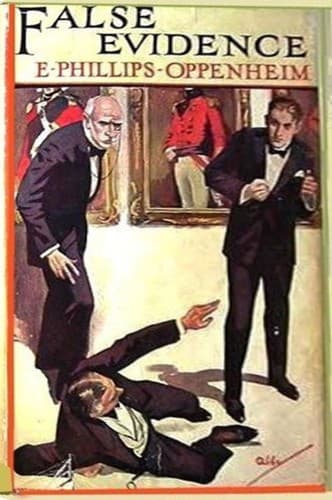
False EvidenceOppenheim, E. Phillips (Edward Phillips)
General
False Evidence
Oppenheim, E. Phillips (Edward Phillips)
Soldiers -- Fiction
During those long days of forced inaction many thoughts troubled me.
Not a single line had I heard from my father since our parting at
Exeter, and his worn, suffering face haunted me day and night, and
filled me with a vague self-reproach. True, little time had gone by
yet, and I had already moved one step forward towards the
accomplishment of my sworn purpose. But--Maud Devereux was she not the
daughter of the man whom we had met on Exmoor, the daughter of my Uncle
Rupert, the man who had blasted my father's life, and thrown a long
shadow over my own! It was a thought which made me toss about restless
and uneasy, and filled me with a vague discontent. I never asked
myself why--I doubt whether I knew, but all the same the feeling was
there.
One afternoon, just as I was getting a little stronger and able to move
about, Sir Francis Devereux gave me the opportunity which I had often
coveted. He alluded indirectly to his son. Summoning up all my
courage I asked him a question.
"Will your son--Mr. Rupert Devereux, isn't it--be down before the
shooting is all over, Sir Francis?" I asked.
His face changed at once. From the courteous, sympathising friend he
became the stiff, dignified aristocrat. His lips were set firmly
together, and there was a decided contraction of his black-grey
eyebrows. Altogether he looked as though he had suddenly remembered
that I was a comparative stranger, and only his land agent, from whom a
personal question of any sort was a decided impertinence.
"Certainly not," he answered, curtly; "my son never visits Devereux."
"And yet it will be his some day," I could not help remarking.
"It will not be his some day. Devereux Court, at my death, will pass
into the hands of another son of mine, or his heir. Would to God it
could crumble into dust first!" the old man added, with a sudden burst
of bitterness.
I could not tell what answer to make, so I remained silent. But I
suppose my face must have told him that I was eager to hear more. He
rose, and walked up and down the room several times, my eyes anxiously
following every movement. How like he was to my father! Age had
wonderfully little bent his figure. There was the same grace of limb
and carriage that I had often admired in my father when we had been
striding side by side across the heather-covered moors, the same long,
finely-carved features, and the same look of trouble stamped on the
brow. But in my father's case it was developed somewhat differently.
It had filled his eyes with a weary, long-suffering look, which seemed
to speak of absolute despair, and unvarying, hopeless grief. There was
more of bitterness and concentrated irritation in Sir Francis's face.
It seemed as though the sorrow would not settle into his being, but was
continually lashing him into acute and active wretchedness. Which was
the harder to bear, I wonder?
Suddenly Sir Francis stopped short in the middle of the room, and
turned round to me.
Public-domain text, read in full here on John Shaqi.
Reviews
Reviews
No reviews yet
Be the first to share your thoughts on this work.
Join the Discussion
Join the discussion
Sign in to leave a comment or review.
Sign InorCreate an account