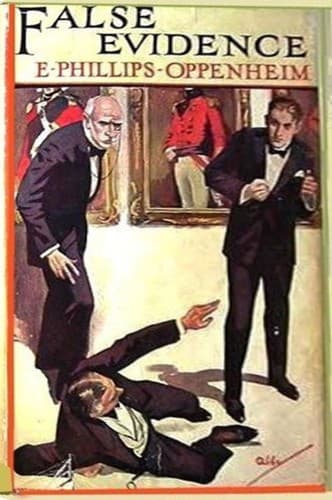
False EvidenceOppenheim, E. Phillips (Edward Phillips)
General
False Evidence
Oppenheim, E. Phillips (Edward Phillips)
Soldiers -- Fiction
"On his own brother's. It was Rupert's word which convicted him,
Rupert's word which has pulled down into the dust the name which
through centuries and centuries has stood as high in honour and
chivalry as any name in Europe. God forgive him! He only did his
duty, but I cannot bear to look upon his face. Not that he wants to
come here! He is a foreigner, and he lives in a foreign country. He
is only half my son! It is Herbert whom I loved."
"And where is he--Herbert?" I asked, fearfully.
"Dead, I hope," he answered, sternly. "Since the day when I heard of
this disgrace I have never looked upon his face. I never wish to look
upon it again. For five-and-twenty years no one has dared to mention
his name in my presence. I have cursed him."
"But if he lives, he is your eldest son, Devereux will be his?"
A passionate fire leaped into Sir Francis's face.
"Never. If I thought that he lived and would come here when I died, I
would fire Devereux Court, though I perished in it. I would cram it
full to the windows with dynamite, and leave not one stone standing
upon another, sooner than he should enter its doors the head of the
Devereuxs. You don't understand this feeling perhaps, Arbuthnot," he
went on, in a lower voice, which was still, however, vibrating with an
intense passion; "some day I will take you into the picture gallery
with me, and then perhaps you will understand it a little better."
"I understand it now, Sir Francis," I told him: "but--but you are sure
that your son Herbert was guilty? Think of the difference which his
disgrace made to Rupert. It made him your heir, virtually your only
son. If he was of a jealous disposition--Spanish people are, they
say--the opportunity of getting rid of Herbert for ever and taking his
place might have tempted him."
I am convinced that the idea which I falteringly suggested to Sir
Francis Devereux had never in the vaguest way presented itself to him
before. Nor was this wonderful. Courteous and polished man of the
world though he was, his nature had preserved all the innate and
magnificent simplicity of the ideal soldier. Falsehood and meanness
were so utterly beneath him that he never looked for them in others.
They represented qualities of which he knew nothing. Any one could
have cheated him, but if by chance detected, the crime would have
seemed to him unpardonable, and from him they would never have won
forgiveness. Herbert, the son whom he loved, had told him a lie--a
court-martial of his fellow-soldiers had determined that it was so--and
the crime had seemed to him scarcely less black than the cowardice. He
had never doubted it for one reason, because the decision of a
court-martial was to him infallible, and for another, because the idea
of falsehood in connection with his other son had never been suggested
to him, and save from another's lips could never have entered into his
mind.
Public-domain text, read in full here on John Shaqi.
Reviews
Reviews
No reviews yet
Be the first to share your thoughts on this work.
Join the Discussion
Join the discussion
Sign in to leave a comment or review.
Sign InorCreate an account