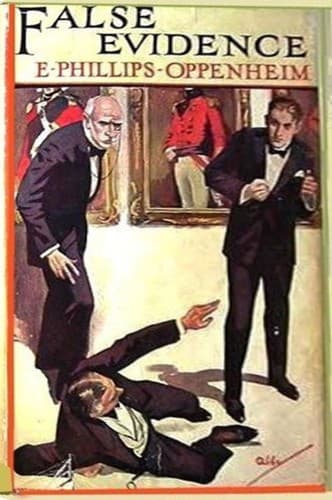
False EvidenceOppenheim, E. Phillips (Edward Phillips)
General
False Evidence
Oppenheim, E. Phillips (Edward Phillips)
Soldiers -- Fiction
"Arbuthnot, my boy," he said, kindly, "I'll tell you about my two sons
if you care to hear the story, in a few words."
"There is nothing I should like so well to hear, Sir Francis," I
answered, in a low tone. He drew near to me and sat down.
"I've taken a strange fancy to you, Arbuthnot," he said, slowly; "I
feel that I should like you to know an old man's sorrow."
His voice was very low indeed, and it seemed to me that his eyes were
dim. Then he began speaking in short sentences, as was his wont, but
with less than his usual curtness.
"I have been married twice, and by each wife I had a son. Herbert was
the name of the elder, Rupert of the younger. Herbert's mother was the
daughter of an English nobleman, and he grew up as fine a young
Englishman as ever walked on God's earth, and a Devereux to the
backbone. Rupert's mother was a Spanish lady, and he resembled her
rather than me. Perhaps you will not be surprised when I tell you
that, although I concealed it as much as possible, Herbert was the son
I loved.
"I made them both enter the army directly they were old enough. Ours
is a fighting family, and from the days of the Conqueror there has
always been a Devereux ready to fight for his country. There, in the
picture gallery, you may see them all, a magnificent race--ay, though I
call them so--of knights and cavaliers and generals. Never has there
been a battle fought in English history but a Devereux has borne arms
in it. I myself was at Inkermann, and led my regiment on into
Sebastopol. A glorious time it was."
He stopped for a moment with sparkling eyes, and a pleased smile on his
lips, as though enjoying keenly the recollection. Then his face
clouded over again, and his head drooped. The change was so complete
and such a sad one that my heart ached for him, and I turned my head
away. He continued in an altered tone.
"Well, I made them both soldiers, and when the time come for them to go
abroad and see active service I parted with them without a pang. In
less than six months Herbert, my eldest son, Herbert Devereux,
returned, disgraced, turned out of his regiment--a coward."
Never had I heard anything so pathetic as the pang with which he seemed
to part with this last word. His voice was shaking, and there was a
hot colour in his checks. Suddenly he turned his back upon me, and I
heard a sob.
"Did you believe it?" I asked, excitedly. "Was it proved? Was there
no shadow of doubt?"
He shook his head. "None. My oldest friend was bound to pronounce him
guilty in open court-martial. It was the bitterest duty he ever
performed, he told me long afterwards. But a soldier's duty stands
high above all personal feelings. Had I been in his place I should
have pronounced the same verdict that he did, though my heart had
snapped in two."
"On whose evidence was he convicted?" I asked.
Sir Francis groaned.
Public-domain text, read in full here on John Shaqi.
Reviews
Reviews
No reviews yet
Be the first to share your thoughts on this work.
Join the Discussion
Join the discussion
Sign in to leave a comment or review.
Sign InorCreate an account