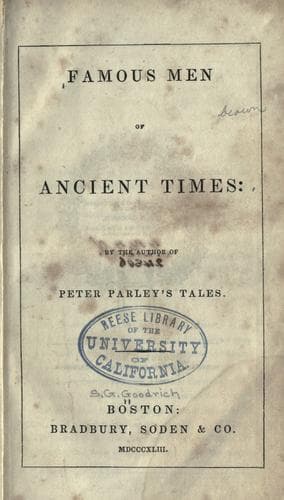
Famous Men of Ancient TimesGoodrich, Samuel G. (Samuel Griswold)
History
Famous Men of Ancient Times
Goodrich, Samuel G. (Samuel Griswold)
Biography -- Juvenile literature; Men -- Biography -- Juvenile literature
It was probably during the thirteen years of his second residence at
Athens, that Aristotle composed or completed the greater part of his
works which have descended to our days. The foundation of most of
them was, doubtless, laid at an early period of his life; but they
appear to have been gradually formed, and to have received continual
additions and corrections. Among the works which especially belong to
this period of his life, are his treatises on Natural History; which,
as has been correctly observed by a late writer on this subject, are
not to be considered as the result of his own observations only, but
as a collection of all that had been observed by others, as well as by
himself.
It is stated by Pliny, that “Alexander the Great, being smitten with
the desire of knowing the natures of animals, ordered several thousand
persons, over the whole of Asia and Greece, who lived by hunting,
bird-catching and fishing, or who had the care of parks, herds,
hives, seines, and aviaries, to furnish Aristotle with materials for
a work on animals.” We are likewise informed that Aristotle received
from Alexander the enormous sum of eight hundred talents,—nearly a
million of dollars, to prosecute his researches in natural history,—a
circumstance which did not escape the malice of his traducers, who
censured him for receiving gifts from princes. Seneca, who states that
Philip furnished Aristotle with large sums of money for his history of
animals, had, doubtless, confounded the father and son.
Callisthenes, a relation of Aristotle, by his recommendation,
attended Alexander in his expedition to Asia, and sent from Babylon
to the philosopher, in compliance with his previous injunctions, the
astronomical observations which were preserved in that ancient city,
and which, according to the statement of Porphyrius, reached back as
far as 1903 years before the time of Alexander the Great; that is, 2234
years before the Christian era.
Public-domain text, read in full here on John Shaqi.
Reviews
Reviews
No reviews yet
Be the first to share your thoughts on this work.
Elsewhere in the archive
Join the Discussion
Join the discussion
Sign in to leave a comment or review.
Sign InorCreate an account