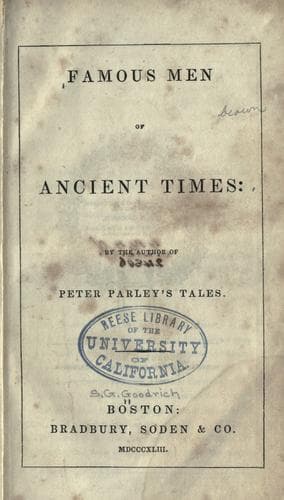
Famous Men of Ancient TimesGoodrich, Samuel G. (Samuel Griswold)
History
Famous Men of Ancient Times
Goodrich, Samuel G. (Samuel Griswold)
Biography -- Juvenile literature; Men -- Biography -- Juvenile literature
Opposition to Macedon was now effectually put down, and, until the
death of Alexander, we hear little more of Demosthenes as a public
man. During this period, however, one of the most memorable incidents
of his life occurred, in that contest of oratory with Æschines, which
has been more celebrated than any strife of words since the world
began. The origin of it was as follows. About the time of the battle
of Cheronea, one Ctesiphon brought before the people a decree for
presenting Demosthenes with a crown for his distinguished services;
a complimentary motion, in its nature and effects very much like a
vote in the English parliament, declaratory of confidence in the
administration. Æschines, the leading orator of the opposite party,
arraigned this motion, as being both untrue in substance and irregular
in form; he indicted Ctesiphon on these grounds, and laid the penalty
at fifty talents, equivalent to about $50,000. Why the prosecution
was so long delayed, does not clearly appear; but it was not brought
to an issue until the year 330, when Æschines pronounced his great
oration “against Ctesiphon.” Demosthenes defended him in the still
more celebrated speech “on the crown.” These, besides being admirable
specimens of rhetorical art, have the additional value, that the rival
orators, being much more anxious to uphold the merits of their own
past policy and conduct, than to convict and defend the nominal object
of prosecution, have gone largely into matters of self-defence and
mutual recrimination, from which much of our knowledge of this obscure
portion of history is derived. Æschines lost the cause, and not having
the votes of so much as a fifth part of the judges, became liable,
according to the laws of Athens, to fine and banishment. He withdrew
to Rhodes, where he established a school of oratory. On one occasion,
for the gratification of his hearers, he recited first his own, then
his adversary’s speech. Great admiration having been expressed of the
latter, “What then,” he said, “if you had heard the brute himself?”
bearing testimony in these words to the remarkable energy and fire of
delivery which was one of Demosthenes’ chief excellences as an orator.
Public-domain text, read in full here on John Shaqi.
Reviews
Reviews
No reviews yet
Be the first to share your thoughts on this work.
Elsewhere in the archive
Join the Discussion
Join the discussion
Sign in to leave a comment or review.
Sign InorCreate an account