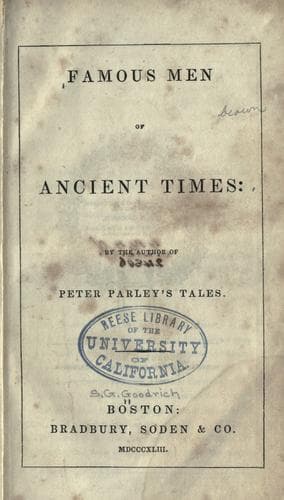
Famous Men of Ancient TimesGoodrich, Samuel G. (Samuel Griswold)
History
Famous Men of Ancient Times
Goodrich, Samuel G. (Samuel Griswold)
Biography -- Juvenile literature; Men -- Biography -- Juvenile literature
Plato was born at Athens, in May, 429 B. C. He was the son of Ariston
and Perectonia. His original name was Aristocles, and it has been
conjectured that he received that of Plato, from the largeness of
his shoulders: this, however, is improbable, as Plato was then a
common name at Athens. Being one of the descendants of Codrus, and
the offspring of a noble, illustrious, and opulent family, he was
educated with the utmost care; his body was formed and invigorated with
gymnastic exercises, and his mind was cultivated and trained by the
study of poetry and of geometry; from which two sources he doubtless
derived that acuteness of judgment and warmth of imagination, which
stamped him as at once the most subtle and flowery writer of antiquity.
He first began his literary career by writing poems and tragedies; but
he was disgusted with his own productions, when, at the age of twenty,
he was introduced into the society of Socrates, and was qualified to
examine, with critical accuracy, the merit of his compositions, and
compare them with those of his poetical predecessors. He, therefore,
committed them to the flames. During eight years he continued to be one
of the pupils of Socrates; and though he was prevented by indisposition
from attending the philosopher’s last moments, he collected, from the
conversation of those that were present, and from his own accurate
observations, very minute and circumstantial accounts, which exhibit
the concern and sensibility of the pupil, and the firmness, virtue, and
elevated moral sentiments of the dying philosopher.
After the death of Socrates Plato retired from Athens, and, with a view
to emerge his stores of knowledge, he began to travel over different
countries. He visited Megara, Thebes, and Elis, where he met with the
kindest reception from his fellow-disciples, whom the violent death
of their master had likewise removed from Attica. He afterwards
visited Magna Græcia, attracted by the fame of the Pythagorean
philosophy, and by the learning, abilities, and reputation of its
professors, Philolaus, Archytas, and Eurytus. He then passed into
Sicily, and examined the eruptions of Etna. He visited Egypt, where the
mathematician Theodorus, then flourished, and where he knew that the
tenets of the Pythagorean philosophy had been fostered.
Public-domain text, read in full here on John Shaqi.
Reviews
Reviews
No reviews yet
Be the first to share your thoughts on this work.
Elsewhere in the archive
Join the Discussion
Join the discussion
Sign in to leave a comment or review.
Sign InorCreate an account