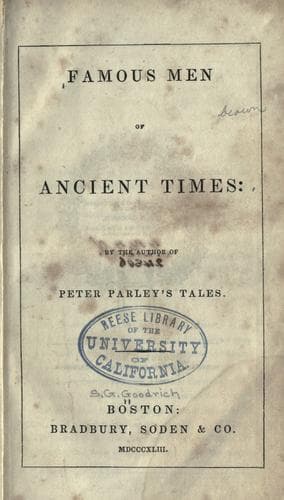
Famous Men of Ancient TimesGoodrich, Samuel G. (Samuel Griswold)
History
Famous Men of Ancient Times
Goodrich, Samuel G. (Samuel Griswold)
Biography -- Juvenile literature; Men -- Biography -- Juvenile literature
This celebrated man, born about 498 B. C., was an Athenian of noble
birth, son of Xantippus and Agariste. He was endowed by nature with
great powers, which he improved by attending the lectures of Damon,
Zeno, and Anaxagoras. Under these celebrated masters, he became a
commander, a statesman, and an orator, and gained the affections
of the people by his great address, and well-directed liberality.
When he took a share in the administration of public affairs, he
rendered himself popular by opposing Cimon, who was the favorite of
the nobility; and, to remove every obstacle which stood in the way of
his ambition, he lessened the dignity and the power of the court of
Areopagus, whom the people had been taught for ages to respect and
venerate.
He continued his attacks upon Cimon, and finally caused him to be
banished by the ostracism. Thucydides also, who had succeeded Cimon
on his banishment, shared the same fate, and Pericles remained, for
fifteen years, the sole minister, and, as it may be said, the absolute
sovereign of a republic which always showed itself so jealous of her
liberties, and which distrusted so much the honesty of her magistrates.
In his ministerial capacity, Pericles did not enrich himself, but the
prosperity of Athens was the object of his administration. He made war
against the Lacedæmonians, and restored the temple of Delphi to the
care of the Phocians, who had been illegally deprived of that honorable
trust.
He obtained a victory over the Sicyonians near Nemæa, and waged a
successful war against the inhabitants of Samos. The Peloponnesian war
was fomented by his ambitious views, and when he had warmly represented
the flourishing state, the opulence and actual power of his country,
the Athenians did not hesitate to undertake a war against the most
powerful republics of Greece—a war which continued for twenty-seven
years, and was concluded by the destruction of their empire and the
demolition of their walls. The arms of the Athenians were, for some
time, crowned with success; but an unfortunate expedition raised
clamors against Pericles, and the enraged populace attributed all their
losses to him. To make atonement for their ill-success, they condemned
him to pay fifty talents.
Public-domain text, read in full here on John Shaqi.
Reviews
Reviews
No reviews yet
Be the first to share your thoughts on this work.
Elsewhere in the archive
Join the Discussion
Join the discussion
Sign in to leave a comment or review.
Sign InorCreate an account