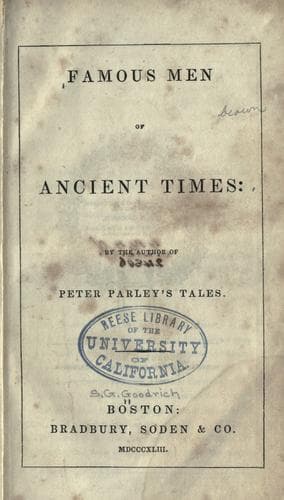
Famous Men of Ancient TimesGoodrich, Samuel G. (Samuel Griswold)
History
Famous Men of Ancient Times
Goodrich, Samuel G. (Samuel Griswold)
Biography -- Juvenile literature; Men -- Biography -- Juvenile literature
The loss of popular favor did not so much affect Pericles, as the death
of all his children. When the tide of disaffection had passed away, he
condescended to come into the public assembly, and viewed with secret
pride the contrition of his fellow-citizens, who universally begged his
forgiveness for the violence which they had offered to his ministerial
character. He was again restored to all his honors, and, if possible,
invested with more power and more authority than before; but the
dreadful pestilence which had diminished the number of his family, and
swept away many of his best friends, proved fatal to himself, and about
429 years B. C., in his seventieth year, he fell a sacrifice to that
terrible malady which robbed Athens of so many of her citizens.
Pericles was forty years at the head of the administration; twenty-five
years with others, and fifteen alone. The flourishing state of the
country under his government, gave occasion to the Athenians publicly
to lament his loss and venerate his memory. As he was expiring
and apparently senseless, his friends, that stood around his bed,
expatiated with warmth on the most glorious actions of his life, and
the victories which he had won—when he suddenly interrupted their
tears and conversation, by saying, that in mentioning the exploits he
had achieved, and which were common to him with all generals, they had
forgotten to mention a circumstance, which reflected far greater glory
on him as a minister, a general, and above all, as a man: “It is,” said
he, “that not a citizen in Athens has been obliged to put on mourning
on my account.”
The Athenians were so affected by his eloquence that they compared it
to thunder and lightning, and, as if he were another father of the
gods, they gave him the title of Olympian. The poets said that the
goddess of persuasion, with all her charms and attractions, dwelt
upon his tongue. When he marched at the head of the Athenian armies,
he observed that he had the command of a free nation, who were Greeks
and citizens of Athens. He also declared that not only the hand of
a magistrate, but also his eyes and his tongue, should be pure and
undefiled. There can be no doubt that Pericles was one of the most
eloquent orators and sagacious statesmen of Greece.
Yet, great and venerable as his character may appear, we must not
forget his follies. His vicious partiality for the celebrated
courtesan, Aspasia, justly subjected him to the ridicule and censure
of his fellow-citizens. The greatness of his talents and his services,
enabled him to triumph over satire and reproach for the time, but the
Athenians had occasion to execrate the memory of a man, who, by his
example, corrupted the purity and innocence of their morals, and who,
associating licentiousness with talents and public virtue, rendered it
almost respectable.
Public-domain text, read in full here on John Shaqi.
Reviews
Reviews
No reviews yet
Be the first to share your thoughts on this work.
Elsewhere in the archive
Join the Discussion
Join the discussion
Sign in to leave a comment or review.
Sign InorCreate an account