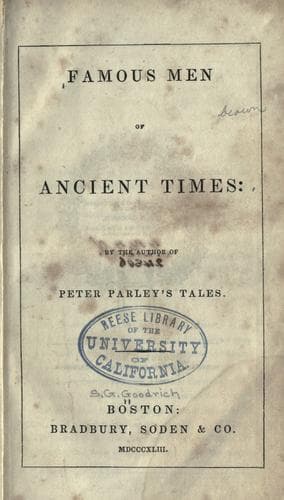
Famous Men of Ancient TimesGoodrich, Samuel G. (Samuel Griswold)
History
Famous Men of Ancient Times
Goodrich, Samuel G. (Samuel Griswold)
Biography -- Juvenile literature; Men -- Biography -- Juvenile literature
Pericles lost all his legitimate children by the pestilence already
mentioned; and to call a natural son by his own name, he was obliged to
repeal a law which he had made against spurious children, and which
he had enforced with great severity. This son, named Pericles, became
one of the ten generals who succeeded Alcibiades in the administration
of affairs, and, like his colleagues, he was condemned to death by the
Athenians, after the unfortunate battle of Arginusæ.
[Illustration]
[Illustration]
ARISTIDES.
This great Athenian general and statesman, who took so conspicuous
a part in the deliverance of Greece from the Persians, and who has
come down to us with the enviable surname of THE JUST, was the son of
Lysimachus and born about the year 550 B. C. We know little of the
steps by which he rose to eminence. He was one of the ten generals of
the Athenian forces, when they fought with the Persians at Marathon.
According to the custom, each general held command of the army for
one day, in rotation. Aristides, perceiving the disadvantages of
this system, prevailed on his colleagues to give up their command
to Miltiades. To this, in a great measure, must be attributed the
memorable victory of the Greeks upon that occasion.
The year after this, Aristides was archon; and the ambitious
Themistocles, desiring to get rid of him privately circulated a charge
that Aristides was aiming at sovereign power. He succeeded finally in
causing him to be exiled by the ostracism—a vote of banishment, in
which the Athenians used shells for ballots. While the voting, upon
this occasion, was going on, Aristides was among the people; a rustic
citizen, who did not know him, came up and asked him to write the name
of Aristides upon the shell with which he intended to vote. “Has he
ever injured you?” said Aristides. “No,” said the voter, “but I am
tired of hearing him called the ‘_Just!_’”
Aristides left Athens, with prayers for its welfare. He was recalled
at the end of three years, and, forgetting his injury, devoted himself
with ardor and success to the good of his country. In the famous battle
of Platea, he commanded the Athenians, and is entitled to a great share
of the merit of the splendid victory gained by the Greeks. He died at
an advanced age, about 467 B. C. He was so poor that the expenses of
his funeral were defrayed at the public charge, and his two daughters,
on account of their father’s virtues, received a dowry from the public
treasury, when they came to marriageable years.
Public-domain text, read in full here on John Shaqi.
Reviews
Reviews
No reviews yet
Be the first to share your thoughts on this work.
Elsewhere in the archive
Join the Discussion
Join the discussion
Sign in to leave a comment or review.
Sign InorCreate an account