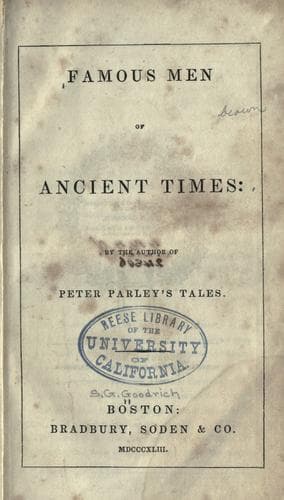
Famous Men of Ancient TimesGoodrich, Samuel G. (Samuel Griswold)
History
Famous Men of Ancient Times
Goodrich, Samuel G. (Samuel Griswold)
Biography -- Juvenile literature; Men -- Biography -- Juvenile literature
The effect of so rare an example as that of Aristides, was visible even
during his lifetime. The Athenians became more virtuous, in imitating
their great leader. Such was their sense of his good qualities, that,
at the representation of one of the tragedies of Æschylus, when the
actor pronounced a sentence concerning moral goodness, the eyes of the
audience were all at once turned from the players to Aristides. When
he sat as judge, it is said that the plaintiff in his accusation—in
order to prejudice him against the defendant—mentioned the injuries
he had done to Aristides. “Mention the wrong _you_ have received,”
said the equitable Athenian. “I sit here as judge; the lawsuit is
yours, not mine.” On one occasion, Themistocles announced to the
people of Athens that he had a scheme of the greatest advantage to the
state; but it could not be mentioned in a public assembly. Aristides
was appointed to confer with him. The design was to set fire to the
combined fleet of the Greeks, then lying in a neighboring port, by
which means the Athenians would acquire the sovereignty of the seas.
Aristides returned to the people, and told them that nothing could be
more advantageous—yet nothing more unjust. The project was of course
abandoned.
The character of Aristides is one of the finest that is handed down by
antiquity. To him belongs the rarest of all praises, that of observing
justice, not only between man and man, but between nation and nation.
He was truly a patriot, for he preferred the good of his country to his
own ambition. A candid enemy, an impartial friend, a just administrator
of other men’s money—an observer of national faith—he is well
entitled to the imperishable monument which is erected in that simple
title, THE JUST!
[Illustration]
ÆSOP.
This celebrated inventor of fables was a native of Phrygia, in Asia
Minor, and flourished in the time of Solon, about 560 B. C. A life of
him was written by a Greek monk, named Planudes, about the middle of
the fourteenth century, which passed into circulation as a genuine
work, but which is proved to have been a mere fiction. In that work,
Æsop is represented as being hunch-backed, and an object of disgust
from his deformity. There appears to be no foundation whatever for this
story. This invention of the monk, no doubt, had for its object, to
give eclat to the beauties of Æsop’s mind, by the contrast of bodily
deformity.
Public-domain text, read in full here on John Shaqi.
Reviews
Reviews
No reviews yet
Be the first to share your thoughts on this work.
Elsewhere in the archive
Join the Discussion
Join the discussion
Sign in to leave a comment or review.
Sign InorCreate an account