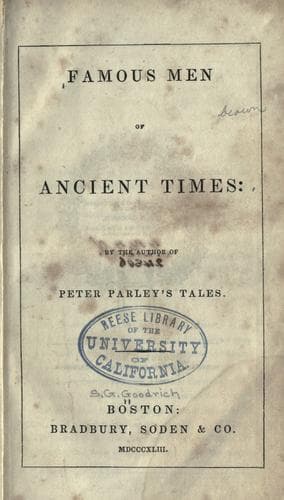
Famous Men of Ancient TimesGoodrich, Samuel G. (Samuel Griswold)
History
Famous Men of Ancient Times
Goodrich, Samuel G. (Samuel Griswold)
Biography -- Juvenile literature; Men -- Biography -- Juvenile literature
Throwing aside the work of Planudes, we are left to grope in obscurity
for the real history of the great fabulist. After the most diligent
researches, we can do little more than trace the leading incidents of
his life. The place of his birth, like that of Homer, is matter of
question; Samos, Sardis, Cotiæum in Phrygia, and Mesembria in Thrace,
laying claim alike to that honor. The early part of his life was spent
in slavery, and the names of three of his masters have been preserved:
Dinarchus, an Athenian, in whose service he is said to have acquired
a correct and pure knowledge of Greek; Xanthus, a Samian, who figures
in Planudes as a philosopher, in order that the capacity of the slave
may be set off by the incapacity of the master; and Iadmon or Idmon,
another Samian, by whom he was enfranchised.
He acquired a high reputation in Greece for that species of
composition, which, after him, was called Æsopian, and, in consequence,
was solicited by Croesus to take up his abode at the Lydian court. Here
he is said to have met Solon, and to have rebuked the sage for his
uncourtly way of inculcating moral lessons. He is said to have visited
Athens during the usurpation of Pisistratus, and to have then composed
the fable of Jupiter and the Frogs[13] for the instruction of the
citizens.
Being charged by Croesus with an embassy to Delphi, in the course of
which he was to distribute a sum of money to every Delphian, a quarrel
arose between him and the citizens, in consequence of which he returned
the money to his patron, alleging that those for whom it was meant
were unworthy of it. The disappointed party, in return, got up the
charge of sacrilege, upon which they put him to death. A pestilence
which ensued was attributed to this crime, and in consequence they made
proclamation, at all the public assemblies of the Grecian nation, of
their willingness to make compensation for Æsop’s death to any one who
should appear to claim it. A grandson of his master, Iadmon, at length
claimed and received it, no person more closely connected with the
sufferer having appeared.
Public-domain text, read in full here on John Shaqi.
Reviews
Reviews
No reviews yet
Be the first to share your thoughts on this work.
Elsewhere in the archive
Join the Discussion
Join the discussion
Sign in to leave a comment or review.
Sign InorCreate an account