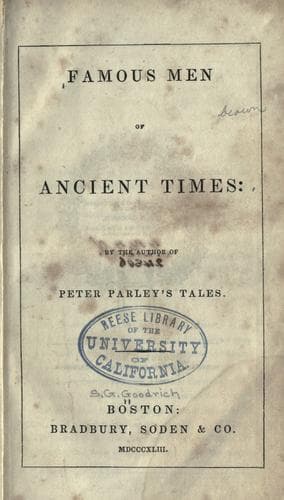
Famous Men of Ancient TimesGoodrich, Samuel G. (Samuel Griswold)
History
Famous Men of Ancient Times
Goodrich, Samuel G. (Samuel Griswold)
Biography -- Juvenile literature; Men -- Biography -- Juvenile literature
[Footnote 14: Croesus was the fifth and last of the Mermadæ, who
reigned in Lydia, and during his time he passed for the richest of
mankind. He was the first who made the Greeks of Asia tributary to
the Lydians. His court was the asylum of learning; and Æsop, the
famous fable-writer, among others, lived under his patronage. In a
conversation with Solon, Croesus wished to be thought the happiest of
mankind; but the philosopher apprized him of his mistake, and gave the
preference to poverty and domestic virtue. Croesus undertook a war
against Cyrus, the king of Persia, and marched to meet him with an army
of 420,000 men, and 60,000 horse. After a reign of fourteen years he
was defeated, B. C. 548; his capital was besieged, and he fell into
the conqueror’s hands, who ordered him to be burnt alive. The pile
was already on fire, when Cyrus heard the conquered monarch exclaim,
“Solon! Solon! Solon!” with lamentable energy. He asked him the reason
of his exclamation, and Croesus repeated the conversation he once had
with Solon, on human happiness. Cyrus was moved at the recital; and,
at the recollection of the inconstancy of human affairs, he ordered
Croesus to be taken from the burning pile, and he was afterwards one
of his most intimate friends. The kingdom of Lydia became extinct in
his person, and the power was transferred to Persia. Croesus survived
Cyrus. The manner of his death is unknown. He is celebrated for the
immensely rich presents which he made to the temple of Delphi, from
which he received an obscure and ambiguous oracle, which he interpreted
in his favor, but which was fulfilled in the destruction of his
empire.]
[Illustration]
LYCURGUS.
This Spartan lawgiver is supposed to have been born about 900 B. C. He
was the youngest son of king Eunomus, and was entitled to the throne
upon the death of his brother, Polydectes; but he relinquished it in
behalf of his unborn son, and administered the government in his name.
By the wisdom of his measures, he won general esteem; and his noble
disinterestedness raised his glory to a height which awoke envy against
him in the minds of some of the most distinguished Spartans, who now
conspired against him. Partly to escape the danger which threatened
him, and partly to gratify the desire of seeing foreign nations, and
learning their manners, he left Sparta, and travelled in various
countries.
After visiting Crete, and admiring the wise laws of Minos, he went to
Iona. The effeminate and luxurious life of the inhabitants, and the
feebleness of their laws, which formed a striking contrast with the
simplicity and vigor of those of Crete, made a deep impression upon
him. Here, however, he is said to have become acquainted with the poems
of Homer, which he collected and carried to Greece. From hence he is
said to have travelled into Egypt, India, and Spain; but this seems
improbable.
Public-domain text, read in full here on John Shaqi.
Reviews
Reviews
No reviews yet
Be the first to share your thoughts on this work.
Elsewhere in the archive
Join the Discussion
Join the discussion
Sign in to leave a comment or review.
Sign InorCreate an account