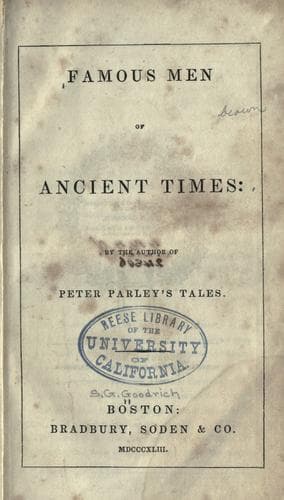
Famous Men of Ancient TimesGoodrich, Samuel G. (Samuel Griswold)
History
Famous Men of Ancient Times
Goodrich, Samuel G. (Samuel Griswold)
Biography -- Juvenile literature; Men -- Biography -- Juvenile literature
In the meanwhile, the two kings who succeeded him at Sparta, Archelaus
and Charilaus, were esteemed neither by the people nor by the
nobility; and, as there were no laws sufficient to maintain the public
tranquillity, the confusion passed all bounds. In this dangerous
situation, Lycurgus was the only man from whom help and deliverance
could be expected. The people hoped from him protection against
the nobles, and the kings believed that he would put an end to the
disobedience of the people. More than once, ambassadors were sent to
entreat him to come to the assistance of the state.
He long resisted, but at last yielded to the urgent wishes of his
fellow-citizens. At his arrival in Sparta, he found that not only
particular abuses were to be suppressed, but that it would be necessary
to form an entirely new constitution. The confidence which his
personal character, his judgment, and the dangerous situation of the
state, gave him among his fellow-citizens, encouraged him to encounter
all obstacles. The first step which he took, was to add to the kings a
senate of twenty-eight persons, venerable for their age, without whose
consent the former were to undertake nothing. He thus established a
useful balance between the power of the kings and the licentiousness
of the people. The latter at the same time obtained the privilege of
giving their voice in public affairs. They had not, however, properly
speaking, deliberative privileges, but only the limited right of
accepting or rejecting what was proposed by the kings or the senate.
The Spartans conformed in general to the institutions of Lycurgus; but
the equal division of property which he effected, excited among the
rich such violent commotions, that the lawgiver fled to the temple, to
save his life. On the way, he received a blow, which struck out one of
his eyes. He merely turned round, and showed to his pursuers his face
streaming with blood. This sight filled all with shame and repentance;
they implored his pardon, and led him respectfully home. The person who
had done the deed, a young man of rank, and of a fiery character, was
given up to him. Lycurgus pardoned him, and dismissed him, covered with
shame.
After having thus formed a constitution for Sparta, Lycurgus endeavored
to provide for its continuance. He made all the citizens take a
solemn oath that they would change nothing in the laws which he had
introduced, before his return. He then went to Delphi, and asked the
gods whether the new laws were sufficient for the happiness of Sparta.
The answer was, “Sparta will remain the most prosperous of all states
as long as it observes these laws.” He sent this answer to Lacedæmon,
and left his country forever. He died of voluntary starvation, and
ordered his body to be burned, and the ashes scattered in the sea, lest
they should be carried to Sparta, and his countrymen be released from
their oath.
Public-domain text, read in full here on John Shaqi.
Reviews
Reviews
No reviews yet
Be the first to share your thoughts on this work.
Elsewhere in the archive
Join the Discussion
Join the discussion
Sign in to leave a comment or review.
Sign InorCreate an account