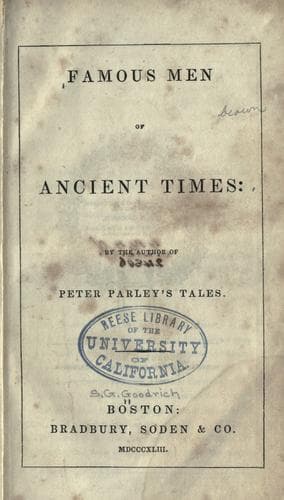
Famous Men of Ancient TimesGoodrich, Samuel G. (Samuel Griswold)
History
Famous Men of Ancient Times
Goodrich, Samuel G. (Samuel Griswold)
Biography -- Juvenile literature; Men -- Biography -- Juvenile literature
Though the patriotism of Lycurgus appears to have been of the most
exalted nature, his institutions were exceedingly barbarous, in many
respects. He cherished no such thing as family ties, but required
everything to yield to the good of the state. The children did not
belong to the parents; feeble children were destroyed; meals were all
taken in common; unmarried men were punished. Thus the private liberty
of the people was taken away, and they were made slaves, in their daily
habits, thoughts and feelings, to that power which was called the
state. The design of the lawgiver seemed to be to rear up a nation of
soldiers—not for conquest, but for defence. He would not permit Sparta
to be encircled with walls, preferring that its defence should depend
on the arms of the citizens. The men were wholly trained for martial
life. Sensibility to suffering, and the fear of death, were treated
with contempt. Victory or death, in battle, was their highest glory;
cowardice was attended with the most deadly shame.
The difference between the institutions of Lycurgus and those of Solon,
may be seen in their results. The Spartans became a stern and haughty
nation of soldiers; but they have left nothing behind but their story,
to instruct mankind; while the Athenians, exalted by the genial breath
of liberty, continue to this very hour to be the admiration of the
world, for their literature, their arts, and their institutions.
[Illustration]
[Illustration]
HOMER.
The Iliad is often spoken of as the greatest production of the human
mind; yet it has been seriously questioned whether such a person
as Homer ever lived! This paradox is to be explained by admitting,
that, although the Iliad is a wonderful performance for the time and
circumstances of its composition, still, it is by no means entitled to
the supremacy which scholastic fondness assigns to it; and that the
doubts thrown upon its authorship are but the mists engendered in the
arena of hypercriticism.
By Homer, we mean the author of the Iliad, whatever may have been his
true name. The period at which he flourished is matter of doubt, but
it is fixed by the Arundelian Marbles,[15] at 907 B. C., which is
probably not far from the true date. A great many tales are handed
down to us, in relation to him, which are mere fictions. The only well
established facts, in his life, are that he was a native of Asiatic
Greece, and a wandering poet, or rhapsodist, who went about the country
reciting his compositions, according to the custom of those times. The
story of his being blind is without authority.
Public-domain text, read in full here on John Shaqi.
Reviews
Reviews
No reviews yet
Be the first to share your thoughts on this work.
Elsewhere in the archive
Join the Discussion
Join the discussion
Sign in to leave a comment or review.
Sign InorCreate an account