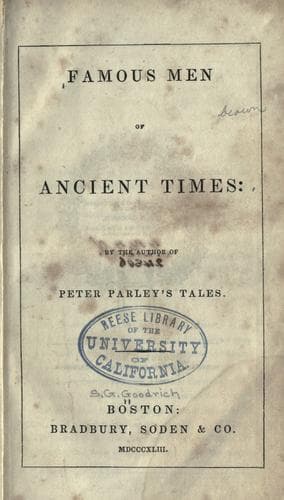
Famous Men of Ancient TimesGoodrich, Samuel G. (Samuel Griswold)
History
Famous Men of Ancient Times
Goodrich, Samuel G. (Samuel Griswold)
Biography -- Juvenile literature; Men -- Biography -- Juvenile literature
Such are the meagre facts which can be gathered amid the obscurity of
that remote age in which Homer lived. There is something painful in
this barrenness,—and we almost feel that the critics, in exploding the
fond fictions which antiquity has woven around the name of the great
poet, have performed an ungracious office. They have indeed dissipated
fables, but they have left us little but darkness or vacuity in their
place. Such is the yearning of the mind, in respect to those who have
excited its emotions, and created an interest in the bosom, that it
will cherish even the admitted portraitures of fiction and fancy,
rather than content itself with the blank canvass of nothingness. The
heart, as well as nature, abhors a vacuum.
The fictitious history of Homer—which, however, is of some antiquity,
and has passed current for centuries—is briefly as follows. His mother
was named Critheis: she was married to Mæon, king of Smyrna, and gave
birth to a child, on or near the banks of the river Meles, from which
circumstance he was called Meles genes. The mother soon died, and he
was brought up and educated under the care of Mæon. The name of Homer
was afterwards given to him, on account of his becoming blind.
The legends proceed in general to state that Homer himself became a
schoolmaster and poet of great celebrity, at Smyrna, and remained
there till Mentes, a foreign merchant, induced him to travel. That the
author of the Iliad and Odyssey must have travelled pretty extensively
for those times, is unquestionable; for besides the accurate knowledge
of Greece which these works display, it is clear that the poet had a
familiar acquaintance with the islands both in the Ægean and the Ionian
seas, the coasts of Asia Minor, Crete, Cyprus, and Egypt—which still
bear the names he gave them—and possessed also distinct information
with respect to Lybia, Æthiopia, Phoenicia, Caria and Phrygia.
In his travels, as the legends say, Homer visited Ithaca, and there
became subject to a disease in his eyes, which afterwards terminated in
total blindness. From this island he is said to have gone to Italy, and
even to Spain; but there is no sign, in either of the two poems, of his
possessing any definite knowledge westward of the Ionian sea. Wherever
he went, Homer recited his verses, which were universally admired,
except at Smyrna, where he was a prophet in his own country. At Phocæa,
a schoolmaster, of the name of Thestorides, obtained from Homer a copy
of his poetry, and then sailed to Chios, and there recited these verses
as his own. Homer went soon after to the same place, and was rescued
by Glaucus, a goatherd, from the attack of his dogs, and brought by
him to Bolissus, a town in Chios, where he resided a long time, in the
possession of wealth and a splendid reputation.
Public-domain text, read in full here on John Shaqi.
Reviews
Reviews
No reviews yet
Be the first to share your thoughts on this work.
Elsewhere in the archive
Join the Discussion
Join the discussion
Sign in to leave a comment or review.
Sign InorCreate an account