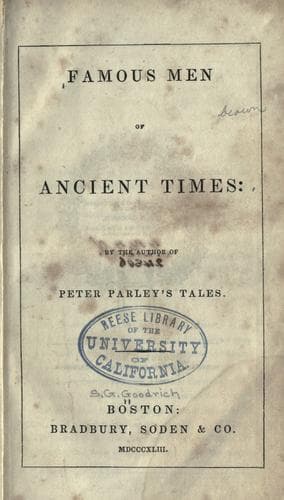
Famous Men of Ancient TimesGoodrich, Samuel G. (Samuel Griswold)
History
Famous Men of Ancient Times
Goodrich, Samuel G. (Samuel Griswold)
Biography -- Juvenile literature; Men -- Biography -- Juvenile literature
Justinian’s chief hope now rested on Belisarius. Assisted by Mundus,
the governor of Illyria, who chanced to be in the capital, he now
called upon the guards to rally in defence of the emperor; but these
refused to obey him. Meanwhile, by another caprice the party of the
Blues, becoming ashamed of their conduct, shrunk one by one away, and
left Hypatius to be sustained by the Greens alone.
These were dismayed at seeing Belisarius, issuing with a few troops
which he had collected, from the smoking ruins of the palace. Drawing
his sword, and commanding his veterans to follow, he fell upon them
like a thunderbolt. Mundus, with another division of soldiers,
rushed upon them from the opposite direction. The insurgents were
panic-struck, and dispersed in every quarter. Hypatius was dragged
from the throne which he had ascended a few hours before, and was soon
after executed in prison. The Blues now emerged from their concealment,
and, falling upon their antagonists, glutted their merciless and
ungovernable vengeance. No less than thirty thousand persons were slain
in this fearful convulsion.
We must now turn our attention to Africa, in which the next exploits
of Belisarius were performed. The northern portion of this part of the
world, known to us by the merited by-word of Barbary, hardly retains a
trace of the most formidable rival and opulent province of Rome. After
the fall of Jugurtha, at the commencement of the second century, it
had enjoyed a long period of prosperity and peace—having escaped the
sufferings which had fallen upon every other portion of the empire. The
Africans in the fifth century were abounding in wealth, population, and
resources. During the minority of Valentinian, Boniface was appointed
governor of Africa. Deceived by Ætius into a belief of ingratitude on
the part of the government at home, he determined upon resistance, and
with this view, concluded a treaty with the Vandals in the southern
portion of Spain.
These, embarking from Andalusia, whose name still denotes their former
residence, landed at the opposite cape of Ceuta, A. D. 429. Their
leader was the far-famed Genseric, one of the most able, but most
lawless and bloody monarchs recorded in history. Of a middle stature,
and lamed by a fall from his horse, his demeanor was thoughtful and
silent; he was contemptuous of luxury, sudden in anger, and boundless
in ambition. Yet his impetuosity was always guided and restrained by
cunning. He well knew how to tempt the allegiance of a foreign nation,
to cast the seeds of future discord, or to rear them to maturity.
Public-domain text, read in full here on John Shaqi.
Reviews
Reviews
No reviews yet
Be the first to share your thoughts on this work.
Join the Discussion
Join the discussion
Sign in to leave a comment or review.
Sign InorCreate an account