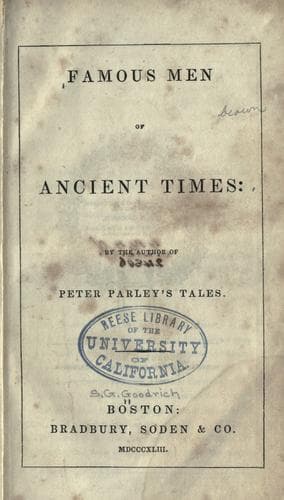
Famous Men of Ancient TimesGoodrich, Samuel G. (Samuel Griswold)
History
Famous Men of Ancient Times
Goodrich, Samuel G. (Samuel Griswold)
Biography -- Juvenile literature; Men -- Biography -- Juvenile literature
The war being thus terminated, Belisarius took up his residence at
Constantinople, and here became the second husband of Antonina, who,
though the child of an actress, had contracted an exalted marriage on
account of her beauty, and having filled a high office, enjoyed the
rank and honors of a patrician. While thus raised above the dangerous
profession of her mother, she still adhered to the morals of the stage.
Though openly licentious, she obtained through her bold, decided, and
intriguing character, aided by remarkable powers of fascination, a
complete ascendancy over Belisarius. It is seldom that a man is great
in all respects, and the weakness of the general whose history we are
delineating, was exhibited in a blind and submissive attachment to this
profligate woman.
A singular outbreak of popular violence occurred about this period,
which stained the streets of Constantinople with blood, and threatened
for a time to hurl Justinian from his throne. The fondness of the
Romans for the amusements of the circus, had in no degree abated.
Indeed, as the gladiatorial combats had been suppressed, these
games were frequented with redoubled ardor. The charioteers were
distinguished by the various colors of red, white, blue, and green,
intending to represent the four seasons. Those of each color,
especially the blue and green, possessed numerous and devoted
partisans, which became at last connected with civil and religious
prejudices.
Justinian favored the Blues, who became for that reason the emblem
of royalty; on the other hand, the Greens became the type of
disaffection. Though these dangerous factions were denounced by the
statutes, still, at the period of which we speak, each party were ready
to lavish their fortunes, risk their lives, and brave the severest
sentence of the laws, in support of their darling color. At the
commencement of the year 532, by one of those sudden caprices which
are often displayed by the populace, the two factions united, and
turned their vengeance against Justinian. The prisons were forced, and
the guards massacred. The city was then fired in various parts, the
cathedral of St. Sophia, a part of the imperial palace, and a great
number of public and private buildings, were wrapped in conflagration.
The cry of “_Nika! Nika!_” Vanquish! Vanquish! ran through every part
of the capital.
The principal citizens hurried to the opposite shore of the Bosphorus,
and the emperor entrenched himself within his palace. In the mean time,
Hypatius, nephew of the emperor Anastatius, was declared emperor by
the rioters, and so formidable had the insurrection now become, that
Justinian was ready to abdicate his crown. For the first and last
time, Theodora seemed worthy of the throne, for she withstood the
pusillanimity of her husband, and, through her animated exhortations,
it was determined to take the chance of victory or death.
Public-domain text, read in full here on John Shaqi.
Reviews
Reviews
No reviews yet
Be the first to share your thoughts on this work.
Join the Discussion
Join the discussion
Sign in to leave a comment or review.
Sign InorCreate an account