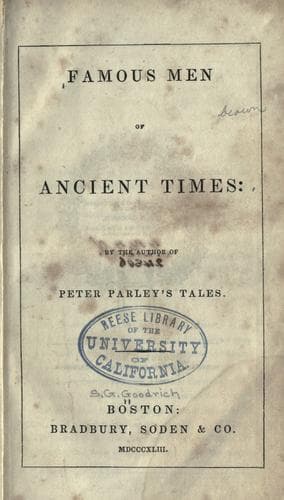
Famous Men of Ancient TimesGoodrich, Samuel G. (Samuel Griswold)
History
Famous Men of Ancient Times
Goodrich, Samuel G. (Samuel Griswold)
Biography -- Juvenile literature; Men -- Biography -- Juvenile literature
The greater part of the life of Confucius was passed in travelling,
visiting the courts of the petty princes, whose states then constituted
the empire under the sovereign of the Chán dynasty. This course was,
as might be expected, fruitless in reforming these states, but it
diffused a general knowledge of himself and his doctrines, and procured
him scholars. The prince of Tsí was the first who invited him to his
court, and received him with distinction. This potentate heard him with
pleasure, and applauded his maxims; but, to the chagrin of Confucius,
he continued to live in luxury, and to allow his ministers to oppress
his subjects and abuse their power. He, however, offered him for his
maintenance the revenue of a considerable city, which the philosopher
thought proper to decline, alleging that he had done nothing to merit
such a recompense. After sojourning a year in Tsí, and seeing that his
discourse produced no effect to reform the abuses and evils of the
country, he left it, and visited some of the principal cities of China.
On the road between Tsí and Chin, he fell into a difficulty. The prince
of Wú having attacked Chin, the lord of Tsú came to his relief, and
sent an invitation to Confucius to join him; but the other party,
fearing that he would do them a disservice, sent people to intercept
him. They surrounded him in the wilderness, and would have starved him
to death, had not a friend come to his relief, after a detention of
seven days. After this narrow escape, he returned home and the prince
of Lú gave him a carriage, two horses and a servant, with which he set
off for King-yang, the capital of the empire. Here he passed his time
in observing the forms of government, the condition of the people and
their manners, and how the rites and ceremonies of the ancient kings
were regarded. He held several interviews with the ministers of the
court, was permitted to visit the emperor’s ancestral hall, and other
sacred places, and had access to the archives of the kingdom, from
which he was allowed to take extracts.
Public-domain text, read in full here on John Shaqi.
Reviews
Reviews
No reviews yet
Be the first to share your thoughts on this work.
Elsewhere in the archive
Join the Discussion
Join the discussion
Sign in to leave a comment or review.
Sign InorCreate an account