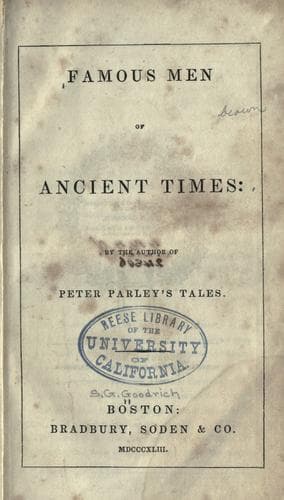
Famous Men of Ancient TimesGoodrich, Samuel G. (Samuel Griswold)
History
Famous Men of Ancient Times
Goodrich, Samuel G. (Samuel Griswold)
Biography -- Juvenile literature; Men -- Biography -- Juvenile literature
One object in the visit of Confucius to the capital, was to see
Láutsz’, the founder of the Táu sect, or Rationalists, who lived in
a retired place, some distance from court. This old philosopher,
accustomed to visits from men of all ranks, received Confucius and his
disciples with indifference. He was reclining on an elevated platform,
and hearing that his visitor had come to hear from his own mouth an
exposition of his tenets, and to ask him about _propriety_, he roused
himself to receive him. “I have heard speak of you,” says he, “and I
know your reputation. I am told that you talk only of the ancients,
and discourse only upon what they taught. Now, of what use is it to
endeavor to revive the memory of men of whom no trace remains on the
earth? The sage ought to interest himself with the times in which he
lives, and regard present circumstances; if they are favorable, he
will improve them; but if, on the contrary, they are unfavorable, he
will retire and wait tranquilly, without grieving at what others do.
He who possesses a treasure, will try to have everybody know it; he
will preserve it against the day of need; this you will do if you are a
sage. It seems, judging by your conduct, that you have some ostentation
in your plans of instruction and that you are proud. Correct these
faults, and purify your heart from all love of pleasure; you will, in
this way, be much more useful than seeking to know what the ancients
said.”
Láutsz’ also observed, “A discreet merchant keeps his affairs to
himself as if he knew nothing; an excellent man, although highly
intelligent, demeans himself like an ignorant man.” Confucius remarked
to his disciples, “I have seen Láutsz’; have I not seen something
like a dragon?” On leaving him, Láutsz’ said, “I have heard that
the rich dismiss their friends with a present, and the benevolent
send away people with a word of advice; whoever is talented, and
prying into everything, will run himself into danger, because he
loves to satirize and slander men; and he who wishes to thoroughly
understand recondite things will jeopard his safety, because he loves
to publish the failings of men.” Confucius replied, “I respectfully
receive your instructions,” and thus left him. Láutsz’ advice seemed
directed against a too inquisitive philosophy, and meddling too much
in the affairs of the world; he was rather of the Budhistic school of
quietists, while Confucius wished men to endeavor to make each other
better.
Public-domain text, read in full here on John Shaqi.
Reviews
Reviews
No reviews yet
Be the first to share your thoughts on this work.
Elsewhere in the archive
Join the Discussion
Join the discussion
Sign in to leave a comment or review.
Sign InorCreate an account