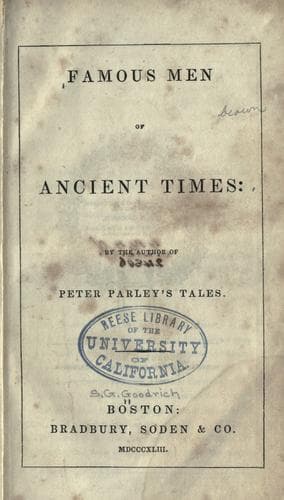
Famous Men of Ancient TimesGoodrich, Samuel G. (Samuel Griswold)
History
Famous Men of Ancient Times
Goodrich, Samuel G. (Samuel Griswold)
Biography -- Juvenile literature; Men -- Biography -- Juvenile literature
Confucius, like Aristotle and other masters, used to teach his
disciples while walking with them, deriving instruction from what they
saw. Once, while walking with them by the bank of a stream, he stopped
from time to time to look very intently at the water, until their
attention was excited, and they were induced to ask him the reason of
his conduct. He replied, “The running of water in its bed is a very
simple thing, the reason of which everybody knows. I was, however,
rather making a comparison in my own mind between the running of water
and doctrine. The water, I reflected, runs unceasingly, by day and by
night, until it is lost in the bosom of the mighty deep. Since the days
of Yáu and Shun, the pure doctrine has uninterruptedly descended to us:
let us in our turn transmit it to those who come after us, that they,
from our example, may give it to their descendants to the end of time.
Do not imitate those isolated men, (referring to Láutsz’,) who are
wise only for themselves. To communicate the knowledge and virtue we
possess, to others, will never impoverish ourselves. This is one of the
reflections I would make upon the running of water.”
This peripatetic habit, and the aptitude for drawing instruction from
whatever would furnish instruction, was usual with the philosopher,
and he seldom omitted to improve an occasion. Once, when walking in
the fields, he perceived a fowler, who, having drawn in his nets,
distributed the birds he had taken into different cages. On coming up
to him to ascertain what he had caught, Confucius attentively remarked
the vain efforts of the captive birds to regain their liberty, until
his disciples gathered round him, when he addressed the fowler,—“I do
not see any old birds here; where have you put them?” “The old birds,”
said he, “are too wary to be caught; they are on the look-out, and if
they see a net or a cage, far from falling into the snare, they escape,
and never return. Those young ones which are in company with them,
likewise escape, but such only as separate into a flock by themselves,
and rashly approach, are the birds I catch. If perchance I catch an old
bird, it is because he follows the young ones.”
Public-domain text, read in full here on John Shaqi.
Reviews
Reviews
No reviews yet
Be the first to share your thoughts on this work.
Elsewhere in the archive
Join the Discussion
Join the discussion
Sign in to leave a comment or review.
Sign InorCreate an account