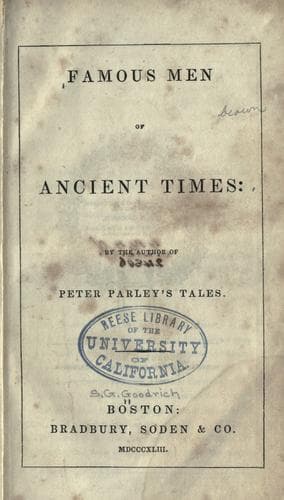
Famous Men of Ancient TimesGoodrich, Samuel G. (Samuel Griswold)
History
Famous Men of Ancient Times
Goodrich, Samuel G. (Samuel Griswold)
Biography -- Juvenile literature; Men -- Biography -- Juvenile literature
“You have heard him,” said Confucius, turning to his disciples; “the
words of this fowler afford us matter for instruction. The young
birds escape the snare only when they keep with the old ones; the old
ones are taken when they follow the young. It is thus with mankind.
Presumption, hardihood, want of forethought, and inattention are the
principal reasons why young people are led astray. Inflated with their
small attainments, they have scarcely made a commencement in learning,
before they think they know everything; they have scarcely performed
a few virtuous acts, and straight they fancy themselves at the height
of wisdom. Under this false impression they doubt nothing; they rashly
undertake acts without consulting the aged and experienced, and thus,
securely following their own notions, they are misled, and fall into
the first snare laid for them. If you see an old man of sober years so
badly advised as to be taken with the giddiness of a youth, attached
to him, and thinking and acting with him, he is led astray by him, and
soon taken in the same snare. Do not forget the answer of the fowler,
but reflect on it occasionally.”
Having completed his observations at the capital, Confucius returned,
by the way of Tsí, to his native state of Lú, where he remained ten
years. His house now became a sort of lyceum, open to every one who
wished to receive instruction. His manner of teaching was to allow
his disciples or others to come and go when they pleased, asking
his opinion on such points, either in morals, politics, history, or
literature, as they wished to have explained. He gave them the liberty
of choosing their subject, and then he discoursed upon it. From these
conversations and detached expressions of the philosopher, treasured
up by his disciples, they afterwards composed Lun Yü, now one of the
Four Books. Confucius, it is said, numbered upwards of three thousand
disciples, or perhaps we ought to call them advocates or hearers
of his doctrine. They consisted of men of all ranks and ages, who
attended upon him when their duties or inclinations permitted, and
who materially assisted in diffusing a knowledge of his tenets over
the whole country. There were, however, a select few, who attached
themselves to his person, lived with him, and followed him wherever he
went; and to whom he entrusted the promulgation of his doctrines.
Public-domain text, read in full here on John Shaqi.
Reviews
Reviews
No reviews yet
Be the first to share your thoughts on this work.
Elsewhere in the archive
Join the Discussion
Join the discussion
Sign in to leave a comment or review.
Sign InorCreate an account