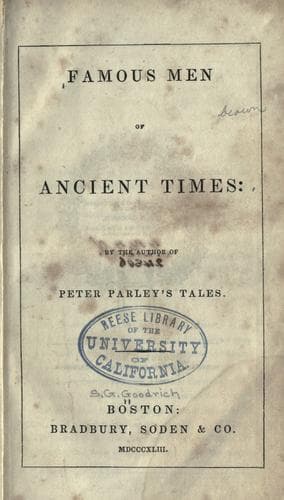
Famous Men of Ancient TimesGoodrich, Samuel G. (Samuel Griswold)
History
Famous Men of Ancient Times
Goodrich, Samuel G. (Samuel Griswold)
Biography -- Juvenile literature; Men -- Biography -- Juvenile literature
In every district in the empire there is a temple dedicated to
Confucius, and his name is usually suspended in every school-room in
the land, and incense is burned before it morning and evening by the
scholars. Adoration is paid to him by all ranks. In 1457, Jentsung,
of the Ning dynasty, set up a copper statue of the sage in one of the
halls of the palace, and ordered his officers, whenever they came to
the palace, to go to this room, and respectfully salute Confucius
before speaking of the affairs of state, even if the monarch were
present. But this custom was represented to another emperor as tending
to the worship of images, like the Budhists; and on that account the
memorialist represented that simple tablets, inscribed with the name of
him who was worshipped, were much better. This advice was followed; the
statues of Confucius and his disciples were suppressed, by order of the
emperor Chítsung, in 1530, and simple tablets have since been set up in
the temples erected to his name.
The writings of Confucius, as might be expected are held in great
veneration, and regarded as the best books in the language. He revised
all the ancient books, containing the precepts of the kings and
emperors of former times, and left them pretty much as they are at the
present day. He explained the Yi King, or Book of Changes, commented
upon the Lí Kí, or Book of Rites, and compiled the Shí King, or Book
of Odes. He composed the Shú King, or Book of Records, and the Chun
Tsaú, or Spring and Autumn Annals,—so called, it is said, because the
commendations contained therein are life-giving, like spring, and the
reproofs are life-withering, like autumn. The books are collectively
called the Wú King, or Five Classics. The Hiáu King, or Memoir on
Filial Duty; the Chung yung, or True Medium; the Tái Hióh, or Superior
Lessons, and the Lun Yü, or Conversations of Confucius, are all
considered, by the Chinese, as containing the doctrines of the sage;
the first one is sometimes ascribed to his own pen. The last three,
with the work of Mencius, constitute the Sz Shü, or Four Books, and
were arranged in their present form by Ching fútsz, about eight hundred
years ago.
Public-domain text, read in full here on John Shaqi.
Reviews
Reviews
No reviews yet
Be the first to share your thoughts on this work.
Elsewhere in the archive
Join the Discussion
Join the discussion
Sign in to leave a comment or review.
Sign InorCreate an account