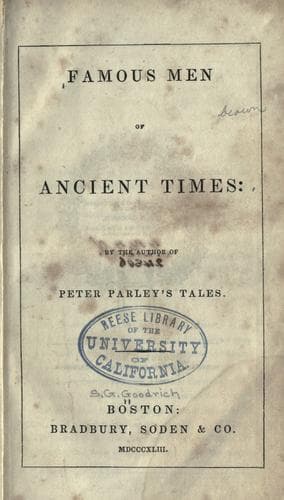
Famous Men of Ancient TimesGoodrich, Samuel G. (Samuel Griswold)
History
Famous Men of Ancient Times
Goodrich, Samuel G. (Samuel Griswold)
Biography -- Juvenile literature; Men -- Biography -- Juvenile literature
The leading features of the morality of Confucius are, subordination
to superiors, and kind, upright dealing with our fellow-men. From the
duty, honor, and obedience owed by a child to his parents, he proceeds
to inculcate the obligations of wives to their husbands, of subjects
to their prince, and of ministers to their king, while he makes him
amenable to Heaven. These principles are perpetually inculcated in
the Confucian writings, and are imbodied in solemn ceremonials, and
apparently trivial forms of mere etiquette. And, probably, it is this
feature of his ethics which has made him such a favorite with all the
governments of China for many centuries past, and at this day. These
principles, and these forms, are early instilled into young minds,
and form their conscience; the elucidation and enforcement of these
principles and forms is the business of students who aspire to be
magistrates or statesmen; and it is no doubt owing in great part, to
the force of these principles on the national mind and habits, that
China holds steadfastly together—the largest associated population
in the world. Every one is interested in upholding doctrines which
give him power over those under him; and as the instruction of his
own youthful days has given him the habit of obedience and respect
to all his superiors, so now, when he is a superior, he exacts the
same obedience from his juniors, and public opinion accords it to
him. The observance of such principles has tended to consolidate the
national mind of China in that peculiar uniformity which has been
remarked by those who have known this people. It has also tended to
restrain all independence of thought, and keep even the most powerful
intellects under an incubus which, while they were prevented by outward
circumstances from getting at the knowledge of other lands was too
great for their unassisted energies to throw off. It cannot be doubted
that there have been many intellects of commanding power among the
Chinese, but ignorance of the literature and condition of other nations
has led them to infer that there was nothing worthy of notice out of
their own borders, and to rest contented with explaining and enforcing
the maxims of their sage.
Public-domain text, read in full here on John Shaqi.
Reviews
Reviews
No reviews yet
Be the first to share your thoughts on this work.
Elsewhere in the archive
Join the Discussion
Join the discussion
Sign in to leave a comment or review.
Sign InorCreate an account