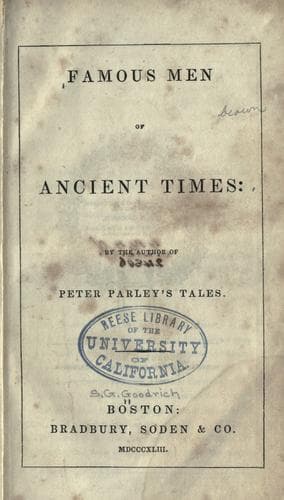
Famous Men of Ancient TimesGoodrich, Samuel G. (Samuel Griswold)
History
Famous Men of Ancient Times
Goodrich, Samuel G. (Samuel Griswold)
Biography -- Juvenile literature; Men -- Biography -- Juvenile literature
Sallying from the city with three hundred mounted men, he met Zabergan
at the head of two thousand cavalry. Selecting a favorable position, he
withstood the onset, and, seeming to recover the powers of his youth,
he astonished all around him by his intrepidity and skill. After a
severe and bloody struggle, the Bulgarians were driven back in the
utmost disorder; four hundred fell on the field, and Zabergan himself
escaped with difficulty. The whole army of barbarians, amounting to
many thousands, were seized with contagious fear, raised their camp,
and retreated to the north.
Belisarius was preparing for a close pursuit, when again his enemies
awaked the suspicions of Justinian by suggesting that he was aiming
at popular favor with disloyal views. The enthusiastic praises of
his heroic conduct, by the people, turned even the emperor’s heart
to jealousy, and he chose rather to purchase the departure of the
barbarians by tribute, than to permit Belisarius to obtain new laurels
by chastising their audacity.
From this period, Belisarius continued under the displeasure of
Justinian, whose suspicious temper seemed to grow more virulent as his
faculties sunk in the dotage of years. In 563, several conspiracies
against the life of Justinian were detected, and under torture, some of
the domestics of Belisarius accused their master of participation. This
testimony, disproved by the long life and the habitually submissive
loyalty of Belisarius, was sufficient for his conviction. He was
stripped of his fortune, deprived of his guards, and detained as a
close prisoner in his palace.
The other conspirators were condemned and executed; but, in
consideration of the past services of Belisarius, the decree of death
was changed for that of blindness, and his eyes were accordingly put
out.[3] He was now restored to liberty, but, deprived of all means
of subsistence, he was compelled to beg his bread before the gates of
the convent of Laurus. There he stood with a wooden platter which he
held out for charity, exclaiming to the passers-by, “Give a penny to
Belisarius the general!”
The affecting scene was long impressed upon the recollection of the
people; and it would seem that this spectacle of persecuted merit
aroused some dangerous feelings of indignation and pity, and he was,
therefore, removed from public view. Belisarius was brought back to his
former palace, and a portion of his treasures was allotted for his use.
His death, which was doubtless hastened by the grief and hardships of
his lot, occurred in 565; and Antonina, who survived him, devoted the
remains of her life and fortune to the cloister.
Public-domain text, read in full here on John Shaqi.
Reviews
Reviews
No reviews yet
Be the first to share your thoughts on this work.
Join the Discussion
Join the discussion
Sign in to leave a comment or review.
Sign InorCreate an account