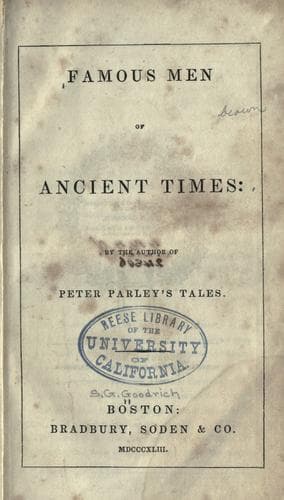
Famous Men of Ancient TimesGoodrich, Samuel G. (Samuel Griswold)
History
Famous Men of Ancient Times
Goodrich, Samuel G. (Samuel Griswold)
Biography -- Juvenile literature; Men -- Biography -- Juvenile literature
In person, Belisarius was tall and commanding; his features regular
and noble. When he appeared in the streets of Constantinople, he never
failed to attract the admiration of the people. As a military leader,
he was enterprising, firm, and fearless. His conception was clear,
and his judgment rapid and decisive. His conquests were achieved with
smaller means than any other of like extent recorded in history. He
experienced reverses in the field; but never did he fail without
strong and sufficient reason. His superior tactics covered his defeats,
retrieved his losses, and prevented his enemies from reaping the fruits
of victory. Never, even in the most desperate emergencies, was he known
to lose his courage or presence of mind.
Though living in a barbarous and dissolute age, Belisarius possessed
many shining virtues. In the march of his armies, he would avoid the
trampling of the corn-fields, nor would he allow his soldiers even to
gather apples from the trees without making payment to the villagers.
After a victory, it was his first care to extend mercy and protection
to the vanquished. The gift of a golden bracelet or collar rewarded
any valorous achievement among his troops; the loss of a horse or
weapon was immediately supplied from his private funds; the wounded
ever found in him a father and a friend. To all, he was open and easy
of access, and by his courteous demeanor often comforted, where he
could not relieve. From his generosity, one would have deemed him rich;
from his manners, poor. His private virtues promoted and confirmed the
discipline of his soldiers. None ever saw him flushed with wine, nor
could the charms of his fairest captives overcome his conjugal fidelity.
But the most remarkable feature in the character of Belisarius is his
steadfast loyalty, and the noble magnanimity with which he overlooked
the suspicious meanness and ingratitude of his sovereign. It is
impossible to find in history another instance of an individual so
strongly induced to rebellion by treacherous treatment on the part of
his country, and the opportunity of placing a crown upon his head
without the risk of effectual opposition, who refused, from patriotic
motives, the double temptation.
That Belisarius had faults, is not to be denied. His blind submission
to his wife displayed great weakness, and led him into most of the
errors which are charged upon his public career. In his last campaign
in Italy, his wealth having been exhausted by an enormous fine, he
endeavored to repair his losses by imitating the rapacity universally
practised by other commanders of that period. He thus inflicted upon
his memory a serious stain, and showed that, however he was exalted
above the age, he was still a man. His whole career affords a striking
moral, coinciding with the emphatic language of Scripture, “Put not thy
trust in princes.”
[Illustration]
Public-domain text, read in full here on John Shaqi.
Reviews
Reviews
No reviews yet
Be the first to share your thoughts on this work.
Join the Discussion
Join the discussion
Sign in to leave a comment or review.
Sign InorCreate an account