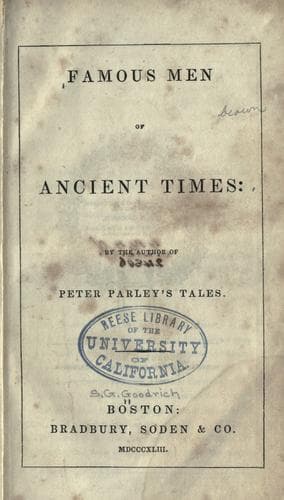
Famous Men of Ancient TimesGoodrich, Samuel G. (Samuel Griswold)
History
Famous Men of Ancient Times
Goodrich, Samuel G. (Samuel Griswold)
Biography -- Juvenile literature; Men -- Biography -- Juvenile literature
Anxious to know the event of the coming battle, Attila consulted
the sorcerers, who foretold his defeat. Though greatly alarmed, he
concealed his feelings, and rode among his warriors, animating them for
the impending struggle. Inflamed by his ardor, the Huns were eager for
the contest. Both armies fought bravely. At length the ranks of the
Romans and Gauls were broken, and Attila felt assured of victory, when,
suddenly, Thorismond, son of Theodoric, swept down like an avalanche
from the neighboring heights upon the Huns. He threw them into
disorder, spread death through their ranks, and Attila, pressed on all
sides, escaped to his camp with the utmost difficulty.
This was the bloodiest battle ever fought in Europe, for 106,000
men lay dead on the field. Theodoric was slain, and Attila, who had
gathered his treasures into a heap, in order to burn himself with them
in case he was reduced to extremities, was left unexpectedly to make
his retreat.
Having returned to Hungary and reinforced his army, he proceeded to
repeat his demand for the hand of Honoria. He mastered the unguarded
passes of the Alps, and, in 452, carried devastation into the north
of Italy. At last he approached the city of Rome, when a supplicatory
embassy met him, Pope Leo I. being at its head. The eloquence of the
pontiff, united to prudential considerations, prevailed, and the city
was saved; Attila returning to his home beyond the Danube. The Romans
looked upon this preservation as a miracle, and they have preserved
a legend that St. Peter and St. Paul appeared to the barbarian, and
threatened him with instant death, if he did not accept the proffered
terms.
Attila now soothed himself by adding the beautiful Ildico to his
numerous wives, whom he wedded with all due ceremony. On this occasion
he gave himself up to licentiousness, but in the morning after his
marriage, he was found dead in his tent, and covered with blood, Ildico
sitting veiled by his side. The story went abroad that he had burst
a blood-vessel, and died in consequence, but a common suspicion is
entertained that he was stabbed by his bride.
The news of Attila’s death spread terror and sorrow among his army.
His body was enclosed in three coffins,—the first of gold, the second
of silver, and the third of iron. The captives who dug his grave were
strangled, so that the place of his burial might not be known.
In person, Attila was marked with the Tartar characteristics, from
which he, as well as the people of his kingdom, were descended. He was
low in stature, broad-chested, and of a powerful frame. He was dark
complexioned, with a few straggling hairs for beard, a flat nose, large
head, and small eyes. No one could look upon him, and not feel that
he had come into the world to disturb it. The number of persons slain
in his battles amounted to hundreds of thousands, yet to so little
purpose, that his empire was immediately dismembered upon his death.
[Illustration]
Public-domain text, read in full here on John Shaqi.
Reviews
Reviews
No reviews yet
Be the first to share your thoughts on this work.
Join the Discussion
Join the discussion
Sign in to leave a comment or review.
Sign InorCreate an account