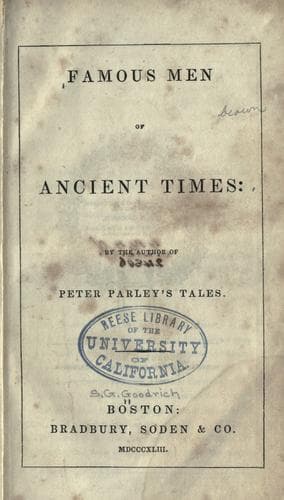
Famous Men of Ancient TimesGoodrich, Samuel G. (Samuel Griswold)
History
Famous Men of Ancient Times
Goodrich, Samuel G. (Samuel Griswold)
Biography -- Juvenile literature; Men -- Biography -- Juvenile literature
They were soon invited to a sumptuous entertainment, in which the
guests were all served upon utensils of silver and gold; but a dish of
plain meat was set before the king on a wooden trencher, of which he
partook very sparingly. His beverage was equally simple and frugal. The
rest of the company were excited into loud and frequent laughter by
the fantastic extravagances of two buffoons; but Attila preserved his
usually inflexible gravity. A secret agent in the embassy was charged
with the disgraceful task of procuring the assassination of this
formidable enemy. Attila was acquainted with this, which was the real
object of the mission, but he dismissed the culprit, as well as his
innocent companions, uninjured. The emperor Theodosius was compelled,
however, to atone for his base attempt, by a second embassy, loaded
with magnificent presents, which the king of the Huns was prevailed
upon to accept. Theodosius died not long after, and was succeeded by
the more virtuous and able Marcian.
Attila was at this time collecting an enormous army, and threatened
both divisions of the Roman world at once. To each emperor he sent
the haughty message, “Attila, my lord and thy lord, commands thee
immediately to prepare a palace for his reception!” To this insult, he
added a demand upon the emperor for the remainder of the tribute due
from Theodosius. Marcian’s reply was in the same laconic style: “I have
gold for my friends, and steel for my enemies!”
Attila determined to make war first on Valentinian. Honoria, the
emperor’s sister, who had been guilty of some youthful error, and was
consequently confined in a convent, had sent Attila a ring, offering to
become his wife. It was to claim her and half the empire as her dower,
that Attila professed to be making these formidable preparations. At
last, he appeared to accept the excuse of Theodosius for not allowing
his sister to become his wife, and speedily marched with a prodigious
force to the westward. He set out in midwinter, and did not pause
till he reached the Rhine. Having defeated the Franks, he cut down
whole forests to make rafts for his army to cross the river, and now,
throwing off the mask, entered Gaul, a dependency of Rome.
The horrors of his march it is scarcely possible to describe.
Everything was destroyed that came in his way. Before him were terror
and despair; behind, a broad track marked with desolation, ruin and
death. He proceeded in his victorious career, till he reached the
ancient town of Orleans. Here an obstinate defence was offered. The
combined armies of Rome, under the celebrated Ætius, and the Goths
under Theodoric, attacked him here, and compelled him to raise the
siege. He retreated to Champaign, and waited for them in the plain of
Chalons. The two armies soon approached each other.
Public-domain text, read in full here on John Shaqi.
Reviews
Reviews
No reviews yet
Be the first to share your thoughts on this work.
Join the Discussion
Join the discussion
Sign in to leave a comment or review.
Sign InorCreate an account