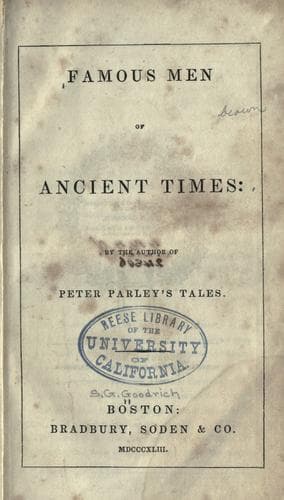
Famous Men of Ancient TimesGoodrich, Samuel G. (Samuel Griswold)
History
Famous Men of Ancient Times
Goodrich, Samuel G. (Samuel Griswold)
Biography -- Juvenile literature; Men -- Biography -- Juvenile literature
In the night he generally sallied out from his palace, to visit the
meanest taverns and the scenes of debauchery in which Rome abounded.
In his nocturnal riots he was fond of insulting the people in the
streets, and on one occasion, an attempt to offer violence to the wife
of a Roman senator nearly cost him his life. He also turned actor, and
publicly appeared on the Roman stage, in the meanest characters. He had
an absurd passion to excel in music, and to conquer the disadvantages
of a hoarse, rough voice, he moderated his meals, and often passed the
day without eating.
The celebrity of the Olympic games having attracted his notice, he
passed into Greece, and presented himself as a candidate for the
public honors. He was defeated in wrestling, but the flattery of the
spectators adjudged him the victory, and Nero returned to Rome with all
the pomp and splendor of an eastern conqueror, drawn in the chariot
of Augustus, and attended by a band of musicians, actors, and stage
dancers from every part of the empire.
These private and public amusements of the emperor were comparatively
innocent; his character was injured, but not the lives of the people.
His conduct, however, soon became more censurable; he was guilty of
various acts which cannot be even named with decency. The cruelty of
his nature was displayed in the sacrifice of his wives Octavia and
Poppæa; and the celebrated writers, Seneca, Lucan, Petronius, &c.,
became the victims of his wantonness. The Christians did not escape
his barbarity. He had heard of the burning of Troy, and as he wished
to renew that dismal scene, he caused Rome to be set on fire in
different places. The conflagration became soon universal, and during
nine successive days the fire was unextinguished. All was desolation;
nothing was heard but the lamentations of mothers whose children had
perished in the flames, the groans of the dying, and the continual fall
of palaces and buildings.
Nero was the only one who enjoyed the general consternation. He placed
himself on a high tower and he sang on his lyre the destruction
of Troy; a dreadful scene which his barbarity had realized before
his eyes. He attempted to avert the public odium from his head, by
a feigned commiseration of the sufferings of his subjects, and by
charging the fire upon the Christians. He caused great numbers of them
to be seized and put to death. Some were covered with the skins of wild
beasts, and killed by dogs set upon them; others were crucified; others
were smeared with pitch and burned, at night, in the imperial gardens,
for the amusement of the people!
Public-domain text, read in full here on John Shaqi.
Reviews
Reviews
No reviews yet
Be the first to share your thoughts on this work.
Join the Discussion
Join the discussion
Sign in to leave a comment or review.
Sign InorCreate an account