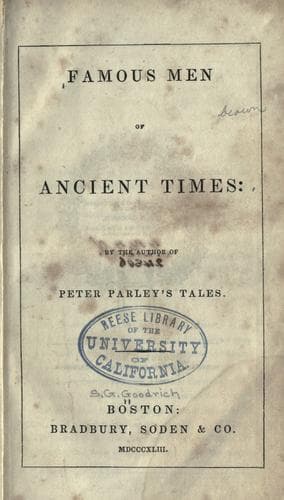
Famous Men of Ancient TimesGoodrich, Samuel G. (Samuel Griswold)
History
Famous Men of Ancient Times
Goodrich, Samuel G. (Samuel Griswold)
Biography -- Juvenile literature; Men -- Biography -- Juvenile literature
Nero began to repair the streets and the public buildings at his own
expense. He built himself a celebrated palace, which he called his
golden house. It was profusely adorned with gold and precious stones,
and with whatever was rare and exquisite. It contained spacious fields,
artificial lakes, woods, gardens, orchards, and every device that
could exhibit beauty and grandeur. The entrance to this edifice would
admit a colossal image of the emperor, one hundred and twenty feet
high; the galleries were each a mile long, and the whole was covered
with gold. The roofs of the dining halls represented the firmament, in
motion as well as in figure, and continually turned round, night and
day, showering all sorts of perfumes and sweet waters. When this grand
edifice, which, according to Pliny, extended all round the city, was
finished, Nero said that he could now lodge like a man!
His profusion was not less remarkable in all his other actions. When
he went fishing, his nets were made with gold and silk. He never
appeared twice in the same garment, and when he undertook a voyage,
there were thousands of servants to take care of his wardrobe. His
continued debauchery, cruelty, and extravagance at last roused the
resentment of the people. Many conspiracies were formed against him,
but they were generally discovered, and such as were accessory,
suffered the greatest punishments. One of the most dangerous plots
against Nero’s life was that of Piso, from which he was delivered
by the confession of a slave. The conspiracy of Galba proved more
successful; for the conspirator, when he was informed that his design
was known to Nero, declared himself emperor. The unpopularity of Nero
favored his cause; he was acknowledged by the whole Roman empire, and
the senate condemned the tyrant, that sat on the throne, to be dragged,
naked, through the streets of Rome, whipped to death, and afterwards
to be thrown from the Tarpeian rock, like the meanest malefactor.
This, however, was not done, for Nero, by a voluntary death, prevented
the execution of the sentence. He killed himself, A. D. 68, in the
thirty-second year of his age, after a reign of thirteen years and
eight months.
Rome was filled with acclamations at the intelligence of this event,
and the citizens, more strongly to indicate their joy, wore caps such
as were generally used by slaves who had received their freedom. Their
vengeance was not only exercised against the statues of the deceased
tyrant, but his friends were the objects of the public resentment, and
many were crushed to pieces in such a violent manner, that one of the
senators, amid the universal joy, said that he was afraid they should
soon have cause to wish for Nero. The tyrant, as he expired, begged
that his head might not be cut off from his body and exposed to the
insolence of an enraged populace, but that the whole might be burned
on a funeral pile. His request was granted, and his obsequies were
performed with the usual ceremonies.
Public-domain text, read in full here on John Shaqi.
Reviews
Reviews
No reviews yet
Be the first to share your thoughts on this work.
Join the Discussion
Join the discussion
Sign in to leave a comment or review.
Sign InorCreate an account