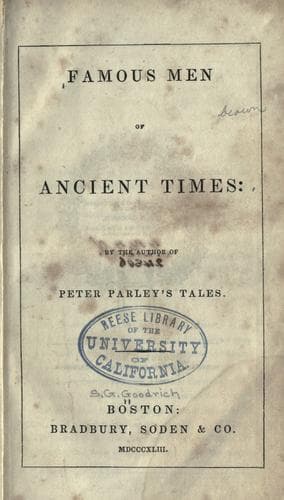
Famous Men of Ancient TimesGoodrich, Samuel G. (Samuel Griswold)
History
Famous Men of Ancient Times
Goodrich, Samuel G. (Samuel Griswold)
Biography -- Juvenile literature; Men -- Biography -- Juvenile literature
Far from being convinced, the assembly was struck silent with mingled
surprise and contempt. The young and enthusiastic Ali, alone, yielded
to his pretences, and, falling at his feet, offered to attend him, in
good or evil, for life or for death. Several of the more sober part of
the assembly sought to dissuade Mohammed from his enterprise; but he
replied with a lofty fervor, that if the sun were placed in his right
hand, and the moon in his left, with power over the kingdoms they
enlighten, he would not, should not, could not hesitate or waver in his
course.
Inflamed by the opposition he met with among this assembly, Mohammed
now went forth, and, wherever he could find crowds of people, there he
announced his mission. In the temples, in the public squares, streets,
and market-places, he addressed the people, laying claim to the
prophetic character, and setting forth the duty of rejecting idolatry,
for the worship of one God. The people were struck with his eloquence,
his majesty of person, the beautiful imagery he presented to their
minds, and the sublime sentiments he promulgated. Even the poet Lebid
is said to have been converted by the wonderful beauty and elevation
of the thoughts poured forth by the professed prophet. The people
listened, and, though they felt the fire of his eloquence, still they
were so wedded to their idolatries, that few were yet disposed to join
him.
To aid in understanding the revolution wrought by Mohammed, it may
be well to sketch the condition of the Arabians at that period. The
original inhabitants of Arabia, though all of one stock, and occupying
a peninsula 1200 miles in length by 700 in width, had been, from
time immemorial, divided into a variety of distinct tribes. These
constituted petty communities or states, which, often changing, still
left the people essentially the same. In the more elevated table lands,
intersected by mountain ridges, with dreary wastes consisting of sandy
plains, the people continued to pursue a roving life, living partly
upon their flocks of camels, horses, and horned cattle, and partly
upon the robbery of trading caravans of other tribes. The people of the
plains, being near the water, settled in towns, cultivated the soil,
and pursued commerce.
The various tribes were each governed by the oldest or most worthy
sheik or nobleman. Their bards met once a year, at Okhad, holding a
fair of thirty days, for the recitation of their productions. That
which was declared to be the finest, was written in gold and suspended
in the great temple of Mecca. This was almost the only common tie
between the several states or tribes, for, although they nominally
acknowledged an emir, or national chief, they had never been brought to
act in one body.
Public-domain text, read in full here on John Shaqi.
Reviews
Reviews
No reviews yet
Be the first to share your thoughts on this work.
Join the Discussion
Join the discussion
Sign in to leave a comment or review.
Sign InorCreate an account