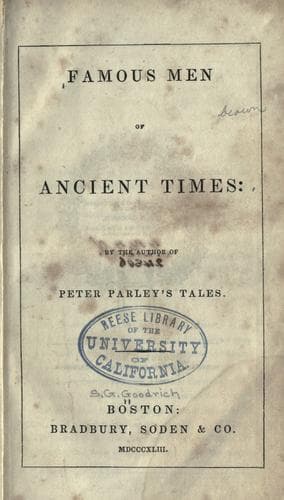
Famous Men of Ancient TimesGoodrich, Samuel G. (Samuel Griswold)
History
Famous Men of Ancient Times
Goodrich, Samuel G. (Samuel Griswold)
Biography -- Juvenile literature; Men -- Biography -- Juvenile literature
The adoration of the Arabians consisted chiefly in the worship of the
heavenly luminaries; but they had a great variety of deities, these
being personifications of certain powers in nature, or passions in
mankind. They were represented by idols of every variety of shape,
which were gathered around the ancient temple of Caaba, at Mecca, a
large square edifice, considered as the central point of religion, and
the favorite seat of divinity. Their worship was attended with the most
horrid rites and shocking ceremonies: even children were sacrificed to
the idols, and one of the tribes was accustomed to bury their daughters
alive. Except that they fancied the souls of the departed to be
transformed into owls, hovering in gloom around the grave, it does not
appear that they had the least idea of a future state of existence.
Such was the state of religion among the native Arabians. Among the
foreign settlers in the towns there were a few followers of the Greek
and Roman philosophy; the Christians were never numerous. These latter
were divided into a variety of sects, and those belonging to the Greek
church, advocated monasteries, and were addicted to the worship of
images, martyrs and relics. Some of these, even elevated the Virgin
Mary into a deity, and addressed her as the third person in the Trinity.
Mohammed, while he no doubt looked with horror upon this state of
things, having studied the Bible, and clearly comprehended its sublime
revelation of one God, conceived the idea of uniting the people of
his native land under a religion of which this fundamental principle
should constitute the basis. His purpose was to crush idolatry, and
restore the lost worship of the true God. How far he was sincere, and
how far he was an impostor, we cannot venture to affirm. It is probable
that he was a religious enthusiast, deceived by his own fancies, and,
perhaps, really believing his own visions. At the outset of his career,
it is likely that he acted in good faith, while he was himself deluded.
When he had advanced so far as to see power and dominion offered
to his grasp, it is probable that his integrity gave way, and that
thenceforward we are to consider him as under the alternate guidance of
craft and fanaticism.
Several of the nobles citizens of Mecca were finally converted by
Mohammed. Khadijah was now dead, and the prophet had married Ayesha,
the daughter of Abubeker, a man of great influence, and who exercised
it in favor of his son-in-law. Yet the new faith made little progress,
and a persecution of its votaries arose, which drove them to
Abyssinia, and caused Mohammed himself to fly for safety to Medina.
This flight is called the Hegira, and, taking place in the year 622, is
the epoch from which Mohammedan chronology is computed, as is ours from
the birth of Christ.
Public-domain text, read in full here on John Shaqi.
Reviews
Reviews
No reviews yet
Be the first to share your thoughts on this work.
Join the Discussion
Join the discussion
Sign in to leave a comment or review.
Sign InorCreate an account