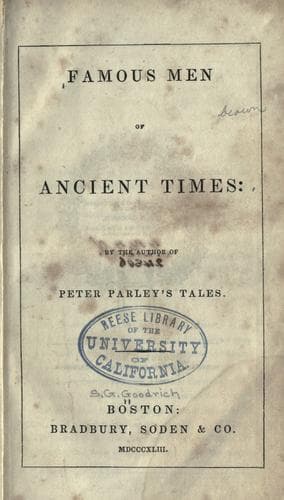
Famous Men of Ancient TimesGoodrich, Samuel G. (Samuel Griswold)
History
Famous Men of Ancient Times
Goodrich, Samuel G. (Samuel Griswold)
Biography -- Juvenile literature; Men -- Biography -- Juvenile literature
[Footnote 6: Tiberius succeeded Augustus Cæsar, as emperor; at his
succession he gave promise of a happy reign, but he soon disgraced
himself by debauchery, cruelty, and the most flagitious excesses. It
was wittily said of him by Seneca that he was never intoxicated but
once, for when he became drunk, his whole life was a continued state of
inebriety. He died A. D. 37, after a reign of twenty-two years, and was
succeeded by Caligula.
For a brief period, Rome now enjoyed prosperity and peace; but the
young emperor soon became proud, cruel and corrupt. He caused a temple
to be erected to himself, and had his own image set in the place of
Jupiter and the other deities. He often amused himself by putting
innocent people to death; he attempted to famish Rome, and even wished
that the Romans had one head, that he might strike it off at a blow! At
last, weary of his cruelties, several persons formed a conspiracy and
murdered him, A. D. 41. History does not furnish another instance of so
great a monster as Caligula.]
[Footnote 7: Claudius succeeded Caligula in 41, and, after a reign of
thirteen years, he was poisoned by his wife, Agrippina.]
[Footnote 8: Seneca, Ess. lxxvii.]
VIRGIL.
Mantua, the capital of New Etruria itself built three centuries before
Rome, had the honor of giving birth to Publius Virgilius Maro. This
event happened on or near the fifteenth of October, seventy years B.
C, or during the first consulship of Pompey the Great and Licinius
Crassus. Who his father was, and even to what country he belonged, has
been the subject of much dispute. Some assert that he was a potter of
Andes; but the most probable account is, that he was either a wandering
astrologer, who practised physic, or a servant to one of this learned
fraternity. It is observed by Juvenal, that _medicus, magus_ usually
went together, and that this course of life was principally followed
by the Greeks and Syrians; to one of these nations, therefore, it
is presumed, Virgil owes his birth. His mother, Maia, was of good
extraction, being nearly related to Quintilius Varus, of whom honorable
mention is made in the history of the second Carthaginian war.
Public-domain text, read in full here on John Shaqi.
Reviews
Reviews
No reviews yet
Be the first to share your thoughts on this work.
Join the Discussion
Join the discussion
Sign in to leave a comment or review.
Sign InorCreate an account