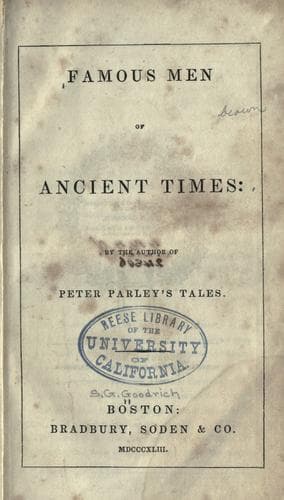
Famous Men of Ancient TimesGoodrich, Samuel G. (Samuel Griswold)
History
Famous Men of Ancient Times
Goodrich, Samuel G. (Samuel Griswold)
Biography -- Juvenile literature; Men -- Biography -- Juvenile literature
Viewed in this light, Seneca’s death had nothing in it of the sublime:
he yielded but to a fashion; he only practised what was common. If he
sincerely believed his professed creed—that death is the absence
of all evil—he neither evinced courage nor dignity; if he did not
believe, then his conduct displayed but the skilful acting of a part,
and under circumstances which mark him with the deepest hypocrisy.
It is impossible to deny that Seneca’s works are full of wisdom, though
they fall far short of the Christian’s philosophy. In his treatise upon
benefits, for example, we have the following passage:—
“The good will of the benefactor is the fountain of all benefits;
nay, it is the benefit itself, or, at least, the stamp that makes it
valuable and current. Some there are, I know, that take the matter
for the benefit, and tax the obligation by weight and measure. When
anything is given them, they presently cast it up—‘What may such a
house be worth? such an office? such an estate?’ as if that were the
benefit which is only the sign and mark of it, for the obligation
rests in the mind, not in the matter; and all those advantages which
we see, handle, or hold in actual possession, by the courtesy of
another, are but several modes or ways of explaining and putting the
good will in execution. There needs no subtlety to prove that both
benefits and injuries receive their value from the intention, when
even brutes themselves are able to decide this question. Tread upon a
dog by chance, or put him in pain upon the dressing of a wound, the
one he passes by as an accident, and the other, in his fashion, he
acknowledges as a kindness. But offer to strike at him—though you do
him no hurt at all—he flies in the face of you, even for the mischief
that you barely meant him.”
This is all just and true: it makes the heart the seat of moral action,
and thus far coincides with the Christian’s philosophy. But if there be
nothing after death, what sanction has virtue? It may be more beautiful
than vice, and consequently preferable, just as a sweet perfume is
more desirable than an offensive odor. It is good taste, therefore,
to be virtuous. Still, each individual may choose for himself, and
without future responsibility, for all alike must share the oblivion
of the tomb. The insufficiency of this philosophy to ensure virtue, is
attested by the life of Seneca, as well as that of most of his sect. It
resulted in the grossest hypocrisy; an ostentation of virtue, covering
up the practice of vice.
[Illustration]
[Footnote 5: The Stoics were the followers of Zeno, a Greek philosopher
of Citium. They professed to prefer virtue to everything else, and
to regard vice as the greatest of evils. They required an absolute
command over the passions, and maintained the ability of man to attain
perfection and felicity in this life. They encouraged suicide, and held
that the doctrine of rewards and punishments was unnecessary to enforce
virtue upon mankind.]
Public-domain text, read in full here on John Shaqi.
Reviews
Reviews
No reviews yet
Be the first to share your thoughts on this work.
Join the Discussion
Join the discussion
Sign in to leave a comment or review.
Sign InorCreate an account