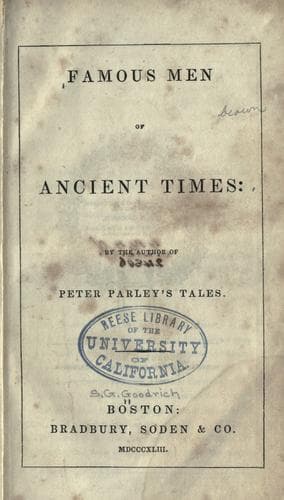
Famous Men of Ancient TimesGoodrich, Samuel G. (Samuel Griswold)
History
Famous Men of Ancient Times
Goodrich, Samuel G. (Samuel Griswold)
Biography -- Juvenile literature; Men -- Biography -- Juvenile literature
To rank among the poets of their country, was, at this time, the
ambition of the greatest heroes, statesmen, and orators of Rome.
Cicero, Octavius, Pollio, Julius Cæsar, and even the stoical Brutus,
had been carried away by the impetuosity of the stream; but that genius
which had never deserted them in the forum, or on the day of battle,
shrunk dismayed at a comparison with the lofty muse of Virgil; and,
although they endeavored, by placing their poems in the celebrated
libraries, to hand them down to posterity, scarcely a single verse of
these illustrious authors survived the age in which they lived. This
preponderence of fashion, however, was favorable to Virgil; he had for
some time devoted himself to the study of the law, and even pleaded one
cause with indifferent success; but yielding now to the impulse of the
age and his own genius, he abandoned the profession and resumed with
increased ardor the cultivation of that talent for which he afterwards
became so distinguished.
Captivated at an early age by the pastorals of Theocritus, Virgil was
ambitious of being the primitive introducer of that species of poetry
among the Romans. His first performance in this way, entitled Alexis,
is supposed to have appeared when the poet was in his twenty-fifth
year. Palæmon, which is a close imitation of the fourth and fifth Idyls
of Theocritus, was probably his second; but as this period of the life
of Virgil is enveloped in a considerable degree of obscurity,—few
writers on the subject having condescended to notice such particulars
as chronological arrangement,—little more than surmise can be
offered to satisfy the researches of the curious. The fifth eclogue
was composed in allusion to the death and deification of Cæsar, and
is supposed to have been written subsequently to Silenus, his sixth
eclogue. This is said to have been publicly recited on the stage, by
the comedian Cytheris, and to have procured its author that celebrity
and applause to which the peculiar beauty and sweetness of the poem so
justly entitled him.
Public-domain text, read in full here on John Shaqi.
Reviews
Reviews
No reviews yet
Be the first to share your thoughts on this work.
Join the Discussion
Join the discussion
Sign in to leave a comment or review.
Sign InorCreate an account