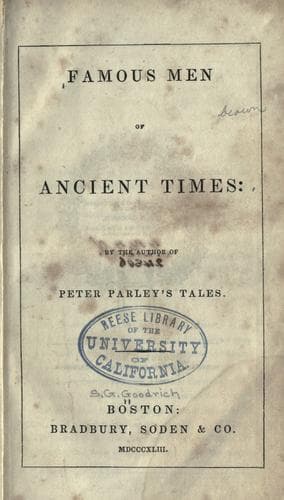
Famous Men of Ancient TimesGoodrich, Samuel G. (Samuel Griswold)
History
Famous Men of Ancient Times
Goodrich, Samuel G. (Samuel Griswold)
Biography -- Juvenile literature; Men -- Biography -- Juvenile literature
The fatal battle of Philippi, in which Augustus and Antony were
victorious, at once annihilated every shadow of liberty in the
commonwealth. Those veteran legions, who had conquered the world,
fought no more for the dearest rights of their country. Having been
once its protectors, they now became its ravagers. As the _amor patria_
no longer inspired them, the treasury of the Roman empire proved
inadequate to allay their boundless thirst for wealth. Augustus,
therefore, to silence their clamors, distributed among them the
flourishing colony of Cremona, and, to make up the deficiency, added
part of the state of Mantua. In vain did the miserable mothers, with
famishing infants at their breasts, fill the forum with their numbers,
and the air with their lamentations; in vain did the inhabitants
complain of being driven, like vanquished enemies, from their native
homes. Such scenes are familiar to the conquerors in a civil war; and
those legions, which had sacrificed their own and their country’s
liberty, must be recompensed at the expense of justice and the
happiness of thousands. Virgil, involved in the common calamity, had
recourse to his old patrons, Pollio and Mecænas;[9] and, supported
by them, petitioned Augustus not only for the possession of his own
property, but for the reinstatement of his countrymen in theirs also;
which, after some hesitation, was denied, accompanied by a grant for
the restitution of his individual estate.
Full of gratitude for such favor, Virgil composed his Tityrus, in
which he has introduced one shepherd complaining of the destruction of
his farm, the anarchy and confusion of the times; and another rejoicing
that he can again tune his reed to love amidst his flocks; promising to
honor, as a superior being, the restorer of his happiness.
Unfortunately for Virgil, his joy was not of long continuance, for, on
arriving at Mantua, and producing his warrant to Arrius, a captain of
foot, whom he found in possession of his house, the old soldier was so
enraged at what he termed the presumption of a poet, that he wounded
him dangerously with his sword, and would have killed him had he not
escaped by swimming hastily over the Mincius. Virgil was, therefore,
compelled to return half the length of Italy, with a body reduced by
sickness, and a mind depressed by disappointment, again to petition
Augustus for the restoration of his estate. During this journey, which,
from the nature of his wound, was extremely slow, he is supposed to
have written his Moeris, or ninth eclogue; and this conjecture is
rendered more probable by the want of connexion, perceivable through
the whole composition—displaying, evidently, the disorder at that time
predominant in the poet’s mind. However, on his arrival at Rome, he had
the satisfaction to find that effectual orders had been given in his
behalf, and the farm was resigned into the hands of his procurator or
bailiff, to whom the above pastoral is addressed.
Public-domain text, read in full here on John Shaqi.
Reviews
Reviews
No reviews yet
Be the first to share your thoughts on this work.
Join the Discussion
Join the discussion
Sign in to leave a comment or review.
Sign InorCreate an account