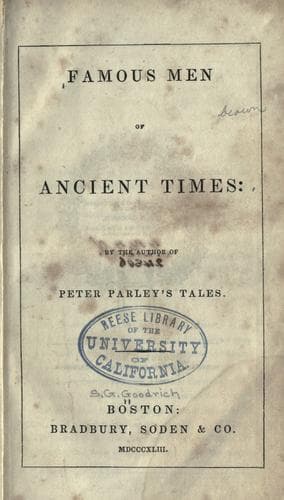
Famous Men of Ancient TimesGoodrich, Samuel G. (Samuel Griswold)
History
Famous Men of Ancient Times
Goodrich, Samuel G. (Samuel Griswold)
Biography -- Juvenile literature; Men -- Biography -- Juvenile literature
[Footnote 9: Mecænas, a celebrated Roman, who distinguished himself
by his liberal patronage of learned men and letters. His fondness for
pleasure removed him from the reach of ambition, and he preferred
to live and die a knight, to all the honors and dignities that the
Emperor Augustus could heap upon him. The emperor received the private
admonitions of Mecænas in the same friendly way in which they were
given. Virgil and Horace both enjoyed his friendship. He was fond of
literature, and from the patronage which the heroic and lyric poets of
the age received from him, patrons of literature have ever since been
called by his name. Virgil dedicated to him his Georgics and Horace his
Odes. He died eight years B. C.]
[Illustration]
CICERO.
Marcus Tullius Cicero was born on the 3d of January, 107, B. C. His
mother, whose name was Helvia, was of an honorable and wealthy family;
his father, named Marcus, was a wise and learned man of fortune, who
lived at Apulia. This city was anciently of the Samnites, now part of
the kingdom of Naples. Here Cicero was born, at his father’s country
seat, which it seems was a most charming residence.
The care which the ancient Romans bestowed upon the education of their
children was worthy of all praise. Their attention to this, began from
the moment of their birth. They were, in the first place, committed to
the care of some prudent matron, of good character and condition, whose
business it was to form their first habits of acting and speaking; to
watch their growing passions, and direct them to their proper objects;
to superintend their sports, and suffer nothing immodest or indecent
to enter into them, that the mind, preserved in all its innocence,
and undepraved by the taste of false pleasures, might be at liberty
to pursue whatever was laudable, and apply its whole strength to that
profession in which it should desire to excel.
Though it was a common opinion among the Romans that children should
not be instructed in letters till they were seven years old, yet
careful attention was paid to their training, even from the age of
three years. It was reckoned a matter of great importance what kind of
language they were first accustomed to hear at home, and in what manner
their nurses, and even their fathers and mothers spoke, since their
first habits were then formed, either of a pure or corrupt elocution.
The two Gracchi were thought to owe that elegance of speaking for which
they were distinguished, to their mother, Cornelia, who was a very
accomplished woman and remarkable for the purity of her diction, as
well in speaking as writing.
Public-domain text, read in full here on John Shaqi.
Reviews
Reviews
No reviews yet
Be the first to share your thoughts on this work.
Join the Discussion
Join the discussion
Sign in to leave a comment or review.
Sign InorCreate an account